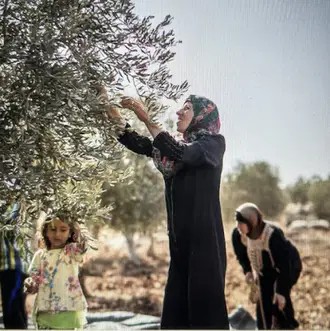
Palestinian Olive Oil used for Holy Oils – Ann Farr

As we approach Holy Week our thoughts and prayers are very much on the Holy Land and particularly on the last days of Jesus, as he approached Jerusalem.

In an act of deep symbolism and solidarity, a number of Catholic and Anglican Dioceses have again chosen Palestinian Olive Oil as the base for their Holy Oils. So far, these include the Catholic Dioceses of Arundel and Brighton and Birmingham, and the Anglican Dioceses of Coventry, and Southwark.

Each year, during the Chrism Mass, the local bishop blesses new oils for the diocese. The holy oils are then taken to each parish, where they are used for Sacramental anointing throughout the year.

This year we are again deeply shocked by all the suffering we see imposed on those in the Holy Land. We have seen indescribable mass destruction of lives, homes and land in Gaza, and the people of the West Bank are seeing destruction and violence that goes far beyond the harassment and obstruction they have experienced for decades. Everyone we met on our solidarity visit in November told us that this was the worst they have ever experienced, and since then it has got worse.

The last olive harvest in Palestine was one of the most difficult in memory. Across the West Bank farmers have faced violence, intimidation and the constant fear of attack. Armed settlers have blocked access to olive groves, set fire to trees and vandalised property. Some have assaulted farmers and their families or threatened them with guns and batons. In some areas, olive trees have been bulldozed or uprooted by the Israeli army. Harvesting for many has become as act of defiance and resilience. Families have had to make an unthinkable choice – to stay away from their groves and let the olives fall, rather than risk their lives and that of their families.

Never has our solidarity and support for the Holy Land been needed more and this Easter it’s good to know that we can be linked in such a special way, through the use of olive oil from the Holy Land, to the Palestinian families who have produced the oil that will be used throughout the year in the Sacraments of the Sick, Baptism and Holy Orders and in the anointing of new bishops.

Canon Rob Esdaile, a priest of Arundel & Brighton Diocese, who has long been active in work for peace and justice, says: “The olive tree has long been a symbol of the heritage of the inhabitants of the Holy Land.

“Psalm 133 uses the vivid image of olive oil running down a man’s beard as a symbol of peace in the community and of  ‘brothers dwelling in unity’, while the same oil was used by Samuel to anoint both King Saul and King David.

“It is beyond tragic that Zionist settlers systematically and deliberately destroy Palestinian olive groves, while the annual olive harvest (always a communal effort in Palestinian villages) in the face of military blockades and the theft of land has become a symbol of resistance and hope. Our liturgical use of Palestinian olive oil is both an act of solidarity and a very physical prayer for the peace of Jerusalem and of the whole Holy Land.”

While we take part in the services of Lent, Holy Week, Easter and Pentecost, we remember that since the war on Iran, all Palestinian places of worship in Jerusalem have been closed by the Israeli Authorities and so denying access to worship for Muslims and Christians. We are asked to keep them in our prayers as we hope for a Just Peace for all in the Holy Land.

If we have missed your Diocese in the list above, please let us know at info@paxchristi.org.uk  and we will make sure you are included.

There is still time to order Palestinian Olive Oil for Holy Week, directly from Zaytoun. It is available in 5 litre cans and in various sized bottles to meet your needs. contact: https://zaytoun.uk  or on

 0207 8321351 or 0781 4477188

Ann Farr,

Pax Christi England and Wales, Pax Christi International, Working Groups for a Just Peace in Palestine and Israel

March 2026
Zealous for the repair of potholes – indifferent to the destruction of lives – Paul McGowan

We stood outside the Council House again, with the same banner as last time. And the time before that. And so on. This time I held the banner with a Muslim. OUR COUNCIL TAX FUNDS THE GENOCIDE. We were there to confront the Council and their investments in weaponry. Some councillors came among us, smiled and took photos. It was because elections are approaching, someone said.

I thought of those who have slipped away into the darkness by the roadside, as Rahner puts it. Some who walked the same road while they could. Some who were there from the start, as the early Church emphasised. It’s a long road, though, and it takes its toll. I ought to pray for them. They have done me good.

Most of those companions, present or departed, wouldn’t set foot in a church if you paid them (and some despite their Baptism). And yet ‘companions’ are those ‘sharing bread’. I share bread every week with many who are not my companions on this road. This is confusing.

Too many of us don’t believe any more that the Devil exists, we were told last Sunday at Mass. These companions I’m talking about, though, would be quite happy to call genocide devilish. And arms-dealers. And the politicians who give the orders and sign the cheques. Demons all. A manner of speaking, you may say. But at least they speak, name names, say something, call a spade a spade.

Hope is much spoken of these days. St Thomas calmly points out that Hope is to be oriented to one who is willing and able to provide the outcome we desire. This seems to rule out our councillors. They are zealous for the repair of potholes, but indifferent to the destruction of lives. And our money pays for both.

Paul McGowan – 27th February 2026

80 Years of the United Nations’ General Assembly

On the 10th January 1946, the first session of the General Assembly of the United Nations was held at Central Hall, Westminster. Delegates from over 50 nations attended and were addressed by the then Prime Minister, Clement Attlee who urged courage in the development of the UN. He said:

“Finally, let us be clear as to what is our ultimate fate. It is not just a negation of war but the creation of a world security and freedom, of a world governed by justice and the moral law: We desire, to assert the pre-eminence of right over might and the general good against selfish sectional aims.”  

It has been only too clear, even in the last few days and weeks, that the role of the United Nations is under threat and that those ‘selfish sectional aims’ are on the rise and preeminent for a number of world leaders.

Our late Vice President Bruce Kent was a fierce defender and promoter of the United Nations and would have urged us to do all we can to make our own support clear. At our AGM last year, Oliver McTernan encouraged us to consider how we, as Pax Christi, could better support the United Nations and a rules based approach to international relations – whilst also recognising the need for urgent reform – not least in the membership and working of the Security Council.

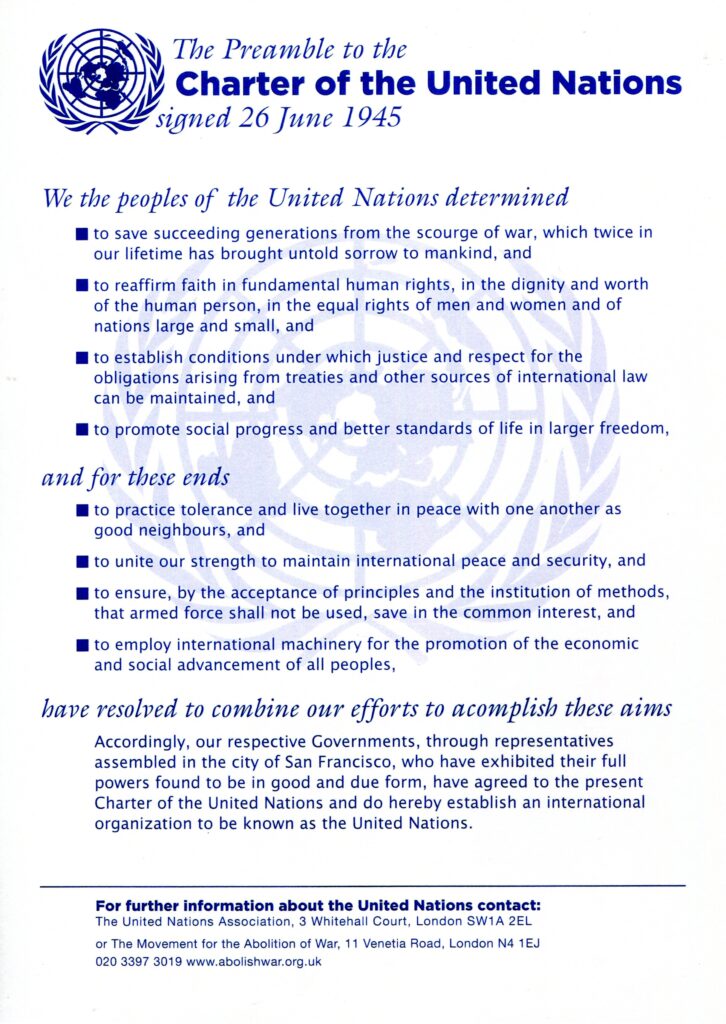
One of the actions Bruce Kent took was to repeatedly print and distribute A4 cards setting out the Preamble to the United Nations Charter. Why not order some of those cards and find somewhere they can be displayed. They are available from the Movement for the Abolition of War website here:

abolishwar.net/shop/preamble-to-the-united-nations-charter/

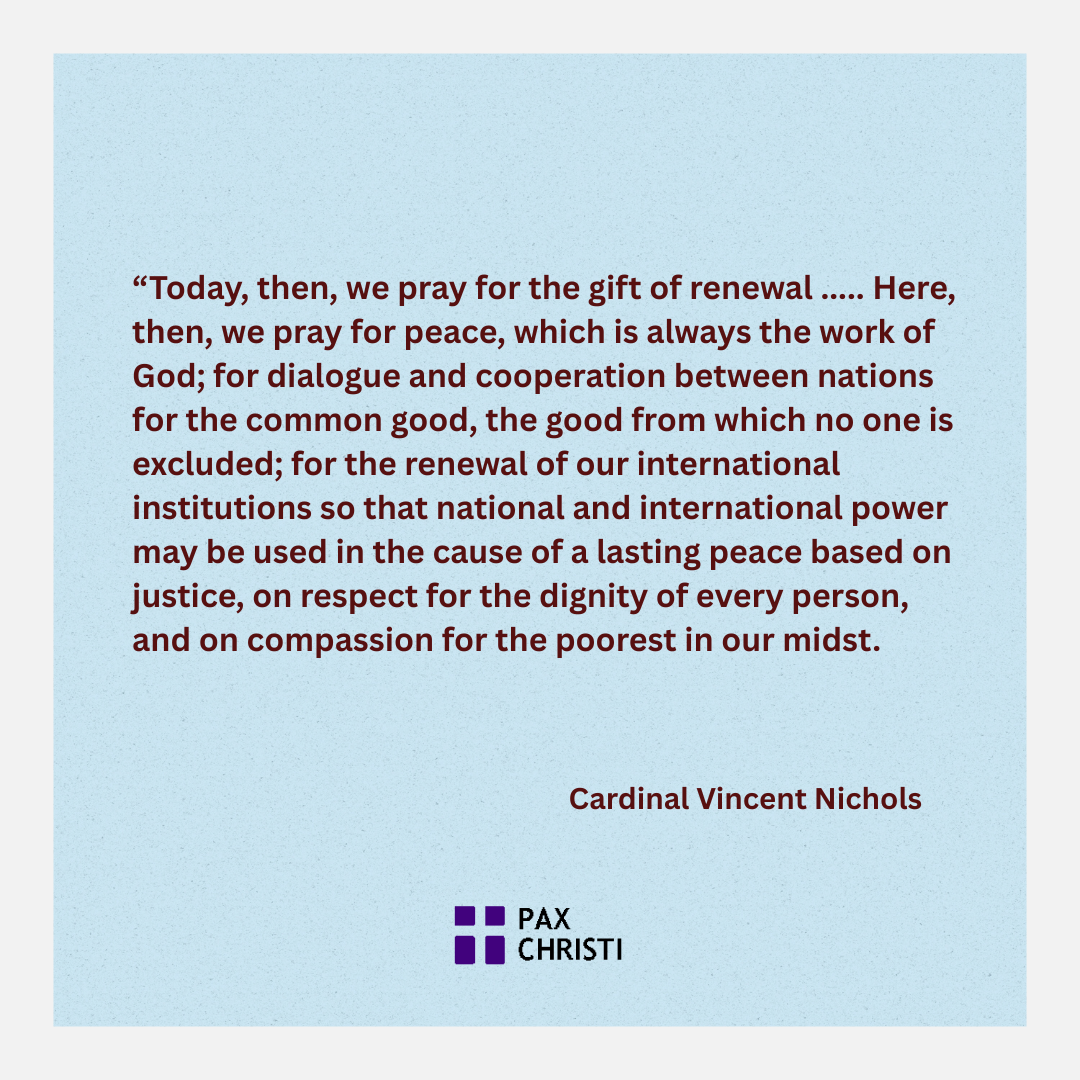
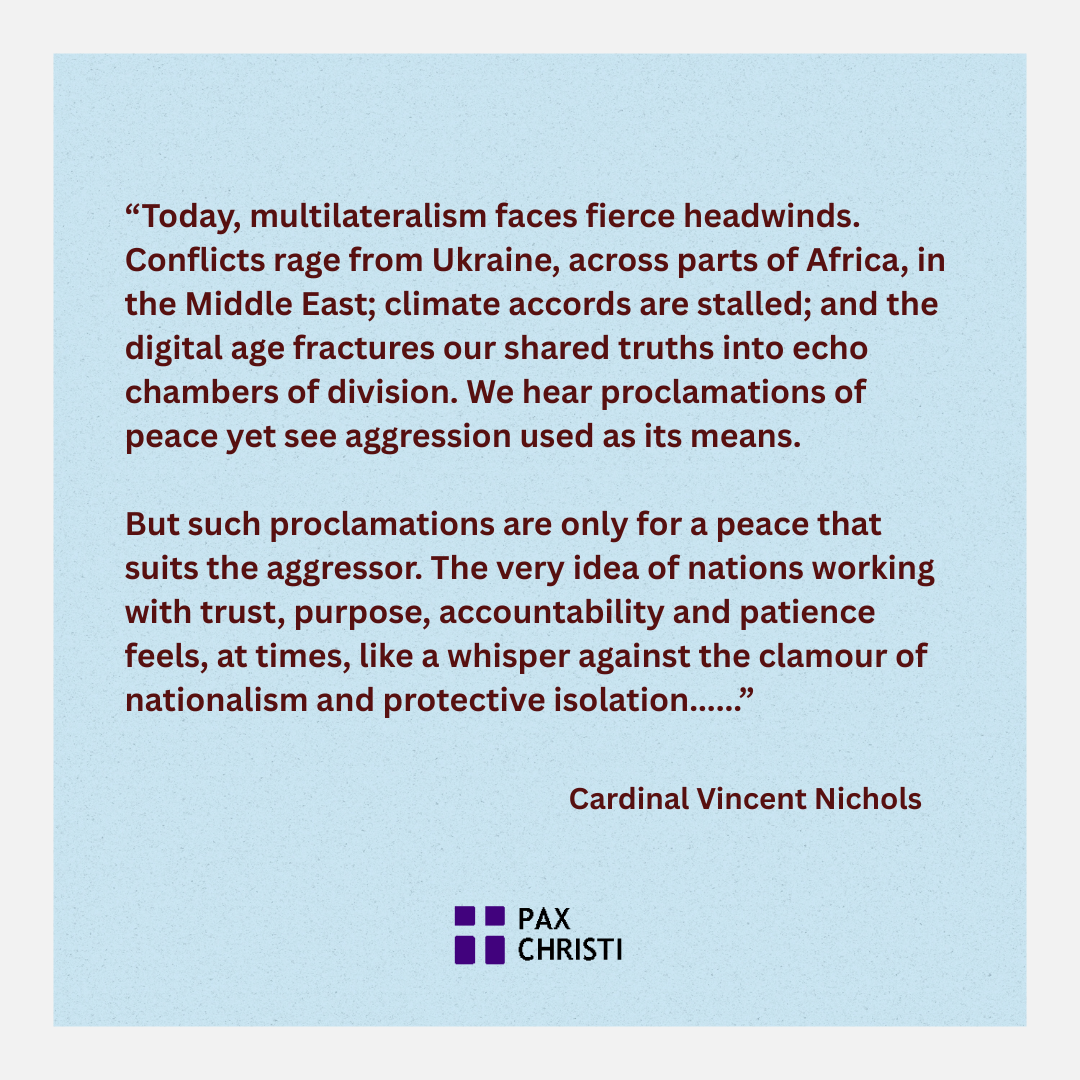
At a Service of Thanksgiving to mark the 80th anniversary of that first meeting of the General Assembly, Cardinal Vincent Nichols gave what our Vice President Pat Gaffney called a ‘most powerful and heartfelt’ homily. We’d recommend reading the homily in full which you can find here:

https://rcdow.org.uk/cardinal/homilies/80th-anniversary-of-the-united-nations

Five years of the Treaty on the Prohibition of Nuclear Weapons

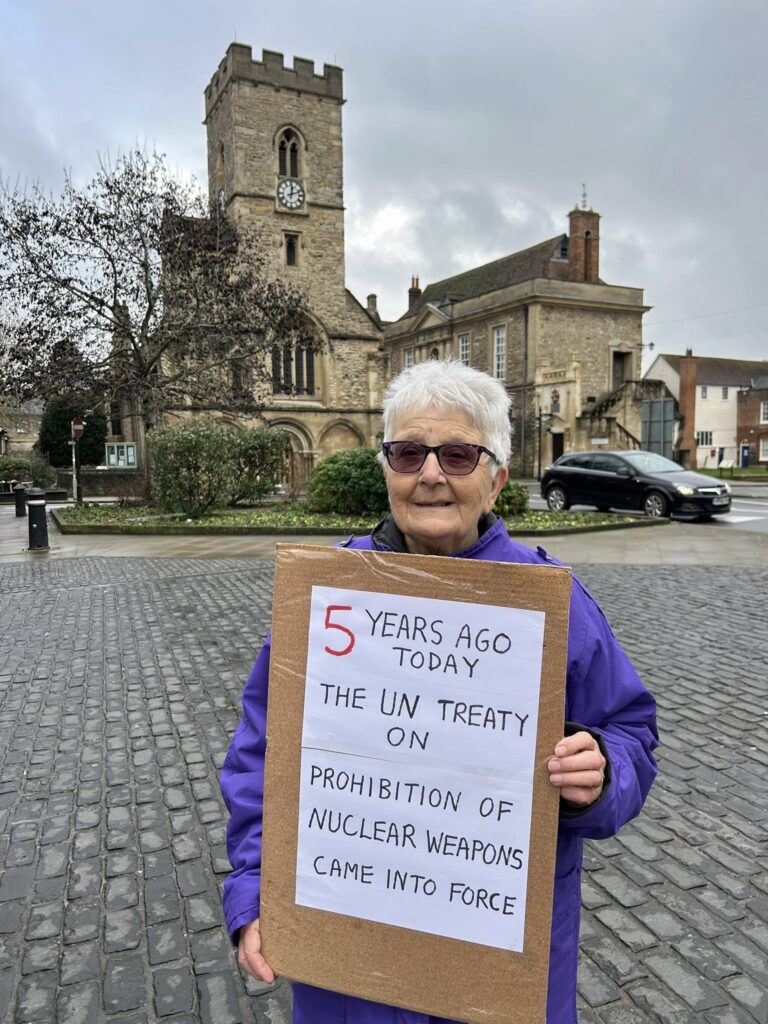
The 22nd January was the 5th Anniversary of the Treaty on the Prohibition of Nuclear Weapons coming into force.

This landmark Treaty imposed a comprehensive ban on nuclear weapons, making it illegal to (amongst other things) develop, possess, use or threaten to use them. A total of 74 states have now ratified or acceded to the Treaty and a further 25 States have signed the Treaty but are yet to ratify it. There is a growing majority bringing moral pressure on the nuclear armed states, including the UK, to make much greater progress on nuclear disarmament.

The Catholic Church supports the Treaty and its aims. The Holy See signed the Treaty on the day it was opened for signature. Both Pope Francis and Pope Leo have confirmed that Catholic teaching requires disarmament and a world free of nuclear weapons. Pope Francis said that it is not just the use of nuclear weapons that is immoral but ‘their very possession’. In his message for the World Day of Peace (the message we reflected on for Peace Sunday last weekend), Pope Leo said ‘The idea of the deterrent power of military might, especially nuclear deterrence, is based on the irrationality of relations between nations, built not on law, justice and trust, but on fear and domination by force’.

The UK’s approach to the TPNW has been recalcitrant, constantly refusing to engage with the Treaty processes whilst at the same time failing to fulfil its obligations as a party to the Nuclear Proliferation Treaty – the treaty which it claims is the only route to nuclear disarmament.

As we mark the 5th anniversary of the TPNW, we confirm that, in the words of the Catholic Bishops’ Conference (England and Wales) in ‘Called to be Peacemakers’, we continue in ‘prayer and public witness’ to campaign for the UK to sign and ratify the Treaty and, until they do, engage meaningfully with the treaty framework, not least in participating as an observer in future meetings of signatories.

Take Action on Nuclear Weapons

If you would like to be involved in our campaigns on Nuclear Weapons, why not join other members and supporters in our Disarmament Working Group ? For more detail, contact us on info@paxchristi.org.uk

Also have a look at our calendar of events where you will find details of a number of upcoming webinars on nuclear weapons themes.

And why not read this short article by Jonathan Frerichs, Pax Christi International Main Representative at UN Geneva:

Half the world’s countries are united in new Nuclear Ban Treaty

Image: Former Vice President and Pax Christi Member Ann Dodd marking the 5th anniversary of the TPNW with Abingdon Peace Group

A meeting of hope – Martin Birdseye

Being more involved with ICAN UK recently, (as Pax Christi’s regular representative) I seized the opportunity to attend a meeting with Melissa Parke, Executive Director of ICAN.  Melissa was in London last week for meetings with MPs and made time for a short in‑person meeting with ICAN UK supporters. 

Not many were present because of short notice but there was a sufficient variety of people to generate an inspiring round-table discussion.

What could have been not much different from an ordinary meeting of ICAN UK supporters, was transformed by having to introduce ourselves and our projects to Melissa, leader of the global ICAN project to abolish nuclear weapons!    The marvellous variety, vision and long-term perseverance of UK campaigning became very apparent.

Having explained my connections with Christian CND and Pax Christi I outlined the ideas and origins of the You Decide nuclear morality flowchart project.  I find that the value of the ethical approach in promoting disarmament is now much better understood (probably since the TPNW and its “ethical imperatives…”) so it’s much easier to explain a logical decide-for-yourself approach to resolving the morality of nuclear deterrence.  Jude Madubuike, now leader of the project, then went on to explain how it is now established as the You Decide CIC, moving ahead and looking for new resources.  We were encouraged by the positive response in this illustrious company.

Melissa briefed us on some latest concerns, and campaign policy.  AI now escalates war scenarios: because while final decisions can be reserved for human intervention, many of the inputs to decision will be generated by AI.  The New Start Treaty is now lapsed.  We have to move the world on from just arms control to disarmament.  Nuclear deterrence must be seen for what it is, the ultimate form of terrorism.  Meanwhile ICAN is working on a platform that will enable more collaborative work among the ICAN partner organisations.  This is work in progress. (We are planning for You Decide to be registered as an ICAN partner organisation.)

A strong theme in discussion was hope.  We have to wake people up but avoid alarmist panic and despair.  Support for abolition depends on a belief that it can be done.

Indeed it can!  Look to the TPNW!

Martin Birdseye

15th February 2026

http://nuclearmorality.com/

https://www.icanw.org/melissa_parke