Nuclear Abolition Day Appeal presented to NPT Review Conference

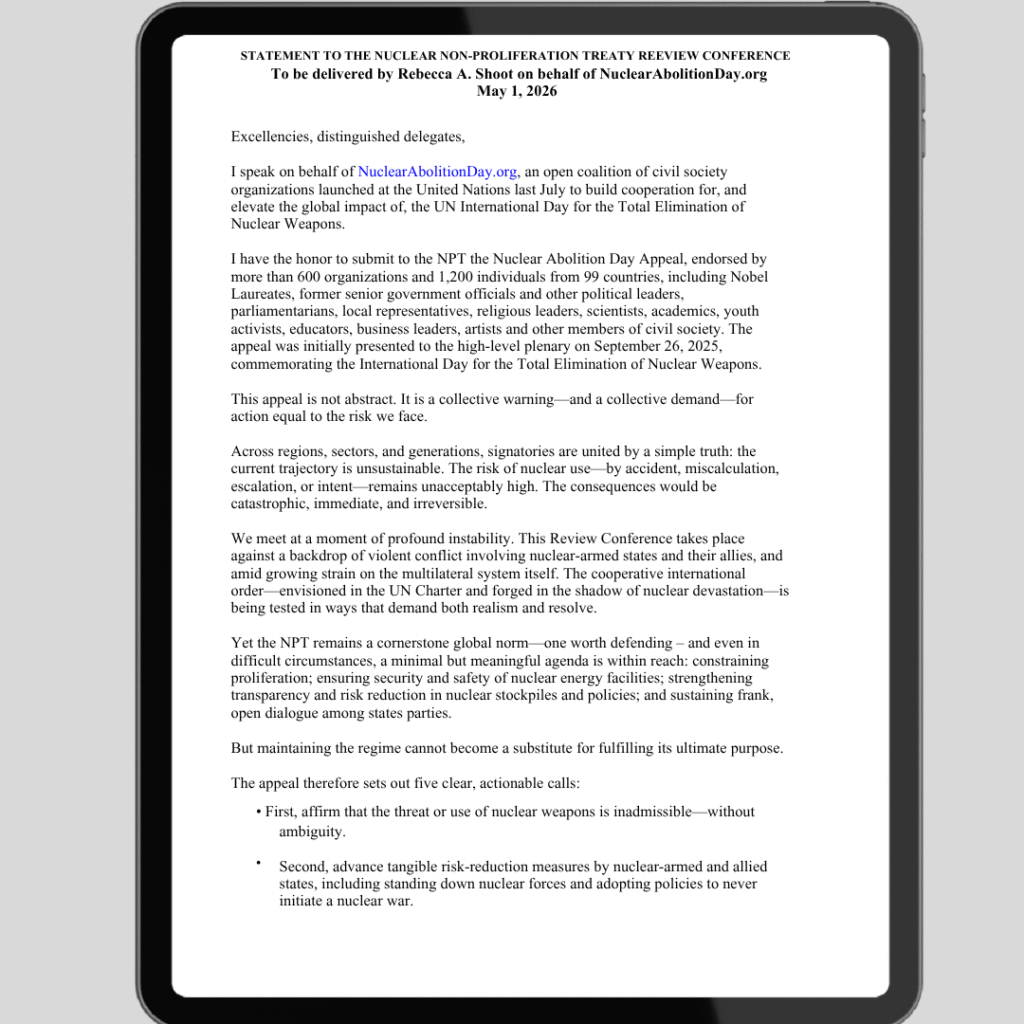
In September 2025, Pax Christi was one of more than 670 organisations and 1400 individuals from 101 countries to endorse an appeal on Nuclear Abolition Day (the UN International Day for the Total Elimination of Nuclear Weapons)

The appeal challenged states to be serious on progress towards disarmament and on the 1st May it was presented to the NPT Review Conference currently underway at the UN in New York.

The appeal calls on States to take action to:

  • affirm that the threat or use of nuclear weapons is inadmissible—without
    ambiguity.
  • advance tangible risk-reduction measures by nuclear-armed and allied
    states, including standing down nuclear forces and adopting policies to never
    initiate a nuclear war.
  • commit to the global elimination of nuclear weapons no later than 2045—
    the centenary of the United Nations—and begin immediate, good-faith steps, to
    achieve it.
  • cut nuclear weapons budgets and end public and private investments in
    the nuclear weapons industry.
  • redirect those resources to what actually sustains human security:
    strengthening the United Nations, advancing peace and conflict resolution,
    addressing the climate crisis, and meeting urgent human needs.

You can read the full statement presenting the appeal here:

Nuclear_Abolition_Org_NPT-Conf-Presentation.pdf

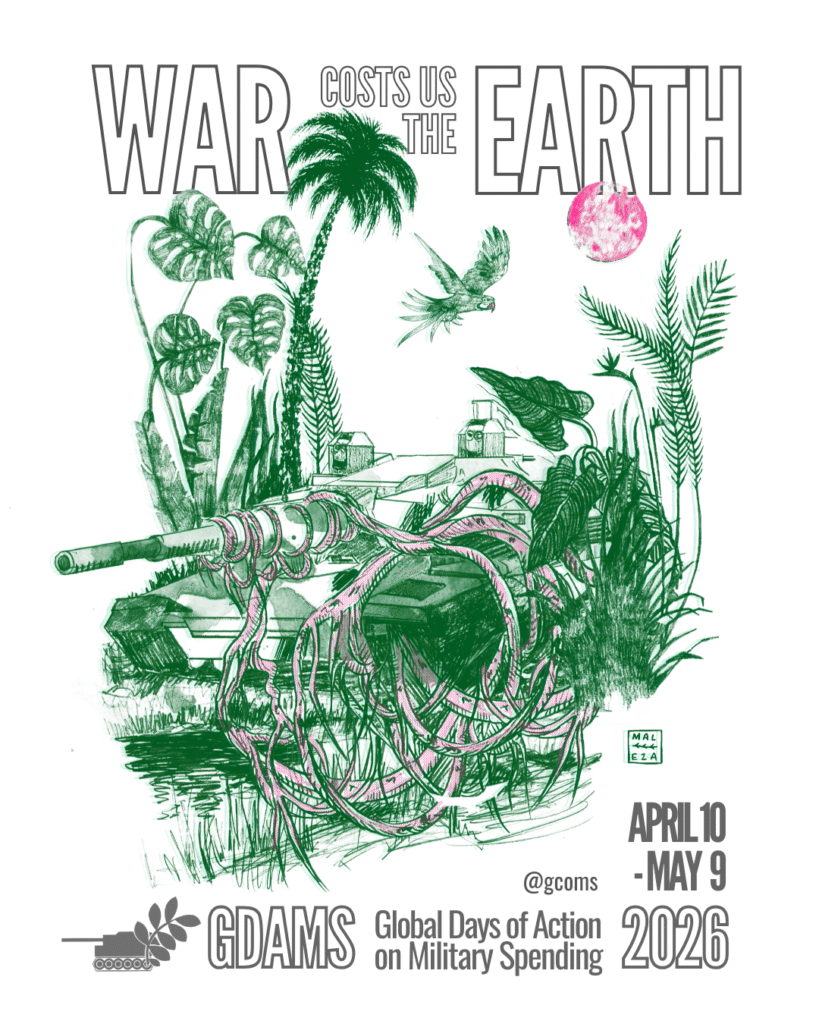
Global Days of Action on Military Spending 2026

We are in the middle of this year’s Global Days of Action on Military Spending and have signed this year’s international appeal.

The appeal challenges the narrative that increases in military spending increase our security and challenges Governments around the world to:

undertake major reductions to their military expenditure and redirect those funds to social and environmental sectors, tackling the global challenges of our time and funding human security’.

You can read the appeal in full here:

GDAMS 2026 Appeal

We are also one of the supporting organisations of Global Campaign on Military Spending UK and you can read the UK GDAMS 2026 appeal here:

GCOMS UK 2026 Appeal

The appeal calls for:

  • The UK government to cancel its proposals to increase spending on the military, specifically the plans to spend 3.5% of GDP during the next parliament.
  • The UK to focus on initiatives aimed at diplomacy, conflict reduction, and disarmament.
  • The highest priority to be given by the government to funding socially productive projects, including the alleviation of poverty and inequality at home and around the world, and stronger efforts to mitigate the climate and nature crises.
  • The UK to adhere to international law and the UN’s international conflict resolution framework, as well as compliance with disarmament treaties and support for the convening of a long-overdue Fourth Special Session on Disarmament, as agreed upon in the UN’s Pact for the Future.

Bamenda’s Witness: Nonviolence in an Upside-Down World

In Bamenda, Cameroon, a city marked by protracted conflict yet faithfully oriented toward reconciliation, Pope Leo XIV articulated a searing theological critique of violence dressed as order. This was not mere pastoral consolation; it was a radical reassertion of the Gospel’s nonviolent logic against the architects of war.

“I am here to proclaim peace,” he began, but immediately destabilized any passive reading of that claim. The locus of proclamation, he insisted, already resides among the people whose “feet” traverse a “bloodstained yet fertile land.” In classical prophetic cadence, he reframed suffering not as silence but as testimony, as witness.

His sharpest intervention targeted the idolatrous fusion of religion and power. Those who “manipulate religion and the very name of God for their own military, economic and political gain,” he warned, enact a form of theological desecration, instrumentalising transcendence for coercion. This is not simply corruption; it is blasphemy embedded in systems.

Equally incisive was his dismantling of the political economy of war. The so-called “masters of war,” he observed, deny an elementary moral truth: “it only takes a moment to destroy, yet often a lifetime is not enough to rebuild.” The allocation of “billions” to destruction, alongside the absence of resources for healing, reveals a global order structured against the Beatitudes.

He pressed further, implicating transnational extraction: wealth drawn from vulnerable lands is transmuted into weapons, perpetuating “an endless cycle of destabilization and death.” This “upside-down world” is, in theological terms, a disordered communion—creation turned against itself.

Against tyrants and billionaires who scandalous accumulation and control, the Pope advances a different eschatology: history bends not through domination, but through a disciplined, collective refusal to participate in violence. To those gathered Pope Leo declared; “Bamenda…you are the city on the hill.”

No more idols! No more war! A prophetic intervention from Pope Leo – Sr Katrina Alton

At the Prayer Vigil for Peace on the 11th April 11, Pope Leo XIV offered not a diplomatic appeal but a theologically charged intervention into a world marked by escalating tensions, destabilising rhetoric from global leaders, and the ongoing devastation faced by millions across the Middle East and beyond. Without naming names, his words unmistakably confront the logic of domination shaping contemporary political discourse.

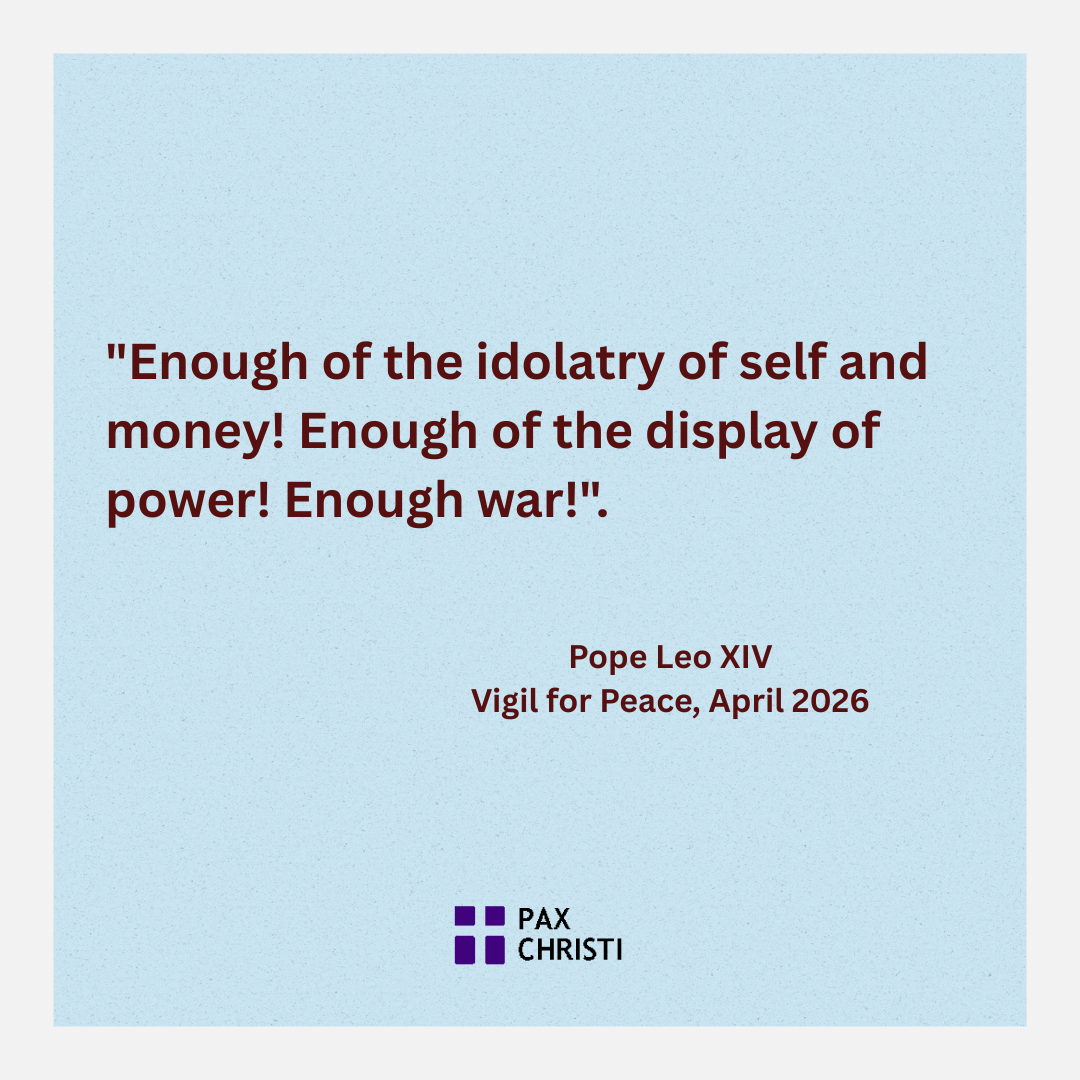
“War divides; hope unites. Arrogance tramples upon others; love lifts up. Idolatry blinds us; the living God enlightens.” These antitheses are not merely rhetorical. They articulate a theological anthropology in which war is not a tragic inevitability but the fruit of disordered desire—what the Christian tradition names idolatry. Hence his uncompromising exhortation: “Enough of the idolatry of self and money! Enough of the display of power! Enough of war!”

Such language exposes the moral contradictions embedded in modern geopolitics. The normalization of violence, whether framed as deterrence, security, or national interest, reveals what the Pope calls a growing “delusion of omnipotence.” More gravely, it signals a theological distortion: “the holy Name of God…is being dragged into discourses of death.” Here, he decisively rejects any attempt to align the God of life with projects of destruction and death.

Central to his reflection is a retrieval of prayer as active, transformative praxis. “Prayer is not a refuge in which to hide from our responsibilities,” he insists. Rather, it is the space where “our limited human possibilities are joined to the infinite possibilities of God,” breaking what he names “the demonic cycle of evil.” Prayer, then, is not withdrawal but participation in God’s reconciling work, it is resistance to violence at its root.

From this theological foundation follows a direct political demand: “Stop! It is time for peace! Sit at the table of dialogue and mediation.” Yet responsibility is not confined to leaders. Violence persists not only through systemic violence and war, but through what he identifies as a “culture of enemies” perpetuated in everyday situations.

Particularly striking is his appeal to children in war zones, whose testimony reveals “all the horror and inhumanity” obscured by political justification. Their witness becomes a moral criterion, exposing the bankruptcy of narratives that sustain war.

“Nothing can confine us to a predetermined fate.” Against political fatalism and theological resignation, Pope Leo articulates an eschatological horizon in which peace is neither naïve nor optional. It is the concrete demand of a humanity called to conversion.

What difference does a prayer vigil make? The Pope answers plainly: “Prayer teaches us to act.” It disrupts our habituation to violence, our quiet complicity in what has been called the myth of redemptive violence, and reorientates thought, word, and deed toward the Kingdom of God: “a Kingdom in which there is no sword, no drone, no vengeance… but only dignity, understanding and forgiveness.”

The challenge, then, is unmistakable. If prayer forms us, it must also send us. Nonviolence is not an abstract ideal but a disciplined practice: refusing the language of enemies, resisting the seductions of power, confronting injustice and violence without mirroring its logic. In a world enthralled by domination, Pope Leo dares to name another possibility, not as aspiration, but as obligation. Peace is not someone else’s task, it is ours, enacted here and now through the risky, concrete work of peace-making and reconciliation.

Stations of the Cross with a difference – Fr Joe Ryan

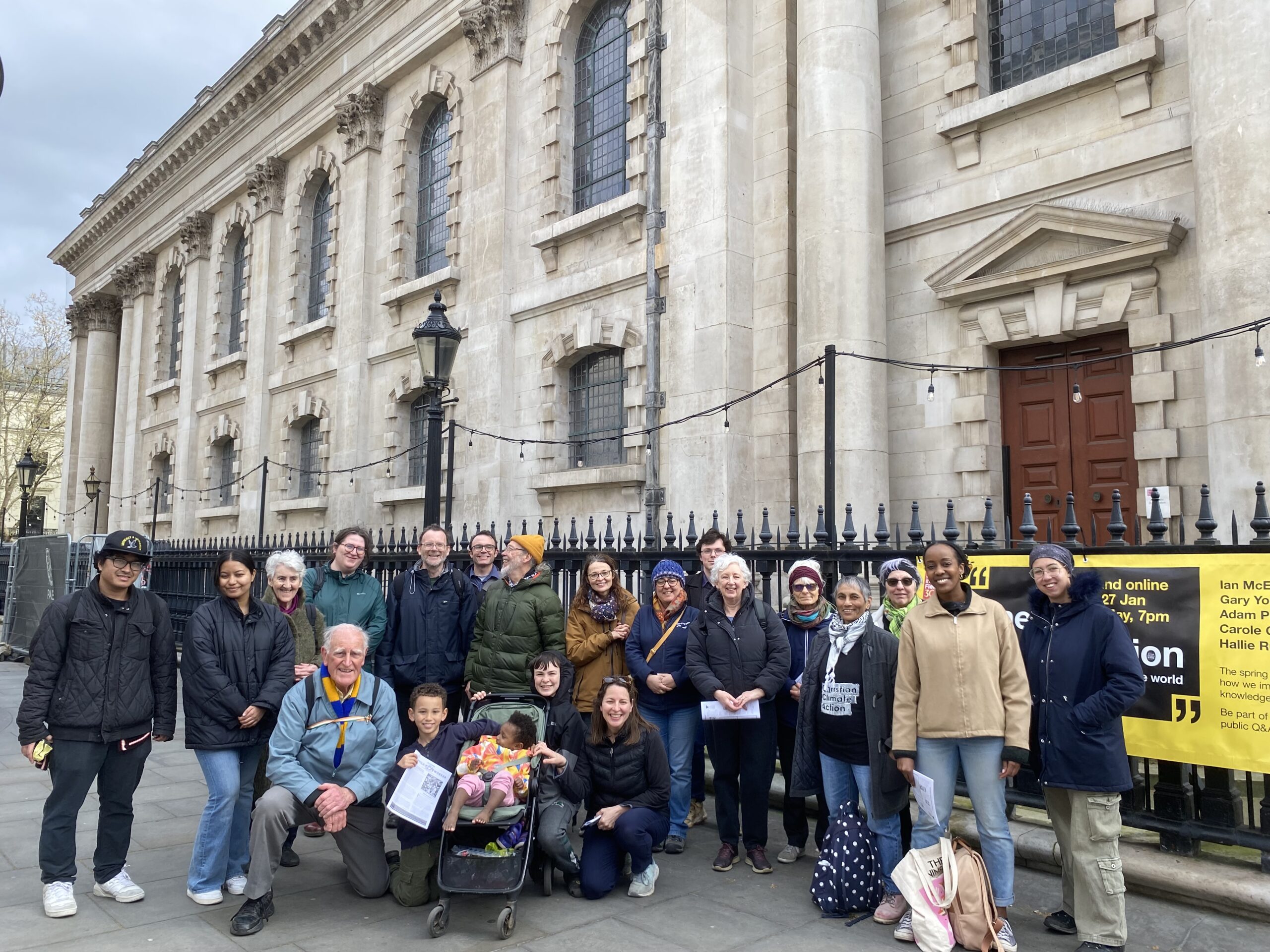
On Holy Saturday a different type of Stations of the Cross were organised by The Catholic Worker, Christian Climate Action, Christians for Palestine and Pax Christi.

We were in Central London visiting various sites; Government buildings, arms manufacturers headquarters; oil & gas companies, mining. companies and other historical sites built on the backs of extraction, slavery the destruction of our climate and the deaths of innocent people.

This was Holy Saturday, a time of waiting and prayer. We are in times of uncertainty in our world today. We are still reeling from the violence of Good Friday. That violence is still with us as people suffer today from war, starvation, greed, inhumanity to the vulnerable and injustices of all kinds.

We tried to meditate on how Jesus is still suffering today in the lives of so many children, women and men. 

At each location/station we remembered Jesus being condemned to death in a mock trial, taking up his cross, falling under that same burden, the consolation of Simon of Cyrene, Veronica and the Women of Jerusalem, the brutality of the Roman soldiers and Jesus nailed to the Cross. We tried to make that connection between the Suffering Christ and human suffering today.

We began at the Home Office, the place responsible for immigration control, security and order. It is also a place that strikes fear into many migrants, many of whom are waiting for decisions about whether they are safe to stay in the UK. Around 150,000 people are awaiting an asylum appeal decision, with a backlog of over 80,000 cases. This is all in the wake of rising hatred-filled rhetoric towards migrants with increasing hostility from the Home  Office and our Government.

We visited the former site of Rolls Royce and QinetiQ at Buckingham Gate. Here we were reminded of the manufacture of the Dreadnought nuclear armed ballistic missile submarines and the security they would supposedly bring us. But we know there are no winners in a nuclear war! In these buildings, the Ministry of Defence is orchestrating the continuing support for vital tests, training in warfare and evaluation in how to maximise the use of weapons of mass destruction.

At Parliament Square, opposite the Houses of Parliament, the centre of democratic power in our country, we reflected on  this scene where many people face arrest in protest of proscription of the group Palestine Action. This action, organised by Defend our Juries, has seen people from all walks of life put their freedom on the line.

At Trafalgar Square, we reflected on the Fourth Plinth; the work of the Mexican artist, Teresa Margolles. It depicts the faces of 726 trans, non-binary and gender non-conforming  people. the idea behind the art piece is rooted in its fragility; exposed to the elements, the faces will slowly disintegrate, showing how some people are marginalised out of existence.

We stood outside Dowing Street and nearby, the Department of Energy Security and Net  Zero and reflected on the Climate Crisis and all its implications.

We visited the Rio Tinto headquarters of the British-Australian mining multinational, responsible for the extraction of natural resources across the world; the BP buildings, one of the world largest companies with licences to extract oil and gas from Iraq, Nigeria, Venezuela and Libya. It shows how entangled the oil and gas industry is in the proliferation of war and genocide.

Finally, back to Trafalgar Square; Nelsons Column reminding us of Imperialism and the 19th century naval supremacy and colonial power giving rise to colonisation, slavery, supressing of indigenous communities and sheer greed supported by power. This exploitation is still very much alive today in the invasion of countries by so-called super powers. We see it day after day in our media.

Then we saw St Martin-in-the fields, a beacon of light and support for the homeless; a place of prayer and musical celebrations lifting the human spirit,  just like the National Gallery celebrating art and human dignity in our troubled world.

These Saturday Stations and reflections have been very powerful and also very challenging. We have to live in the real world and bring to life the reality of the suffering Jesus today. We have to identify and see the face of Jesus on those who suffer; we have to protect God’s creation and yet not hinder development and human growth. It’s like walking a tightrope.

I was so glad to have the opportunity to join with others in that exercise.

Joe Ryan