

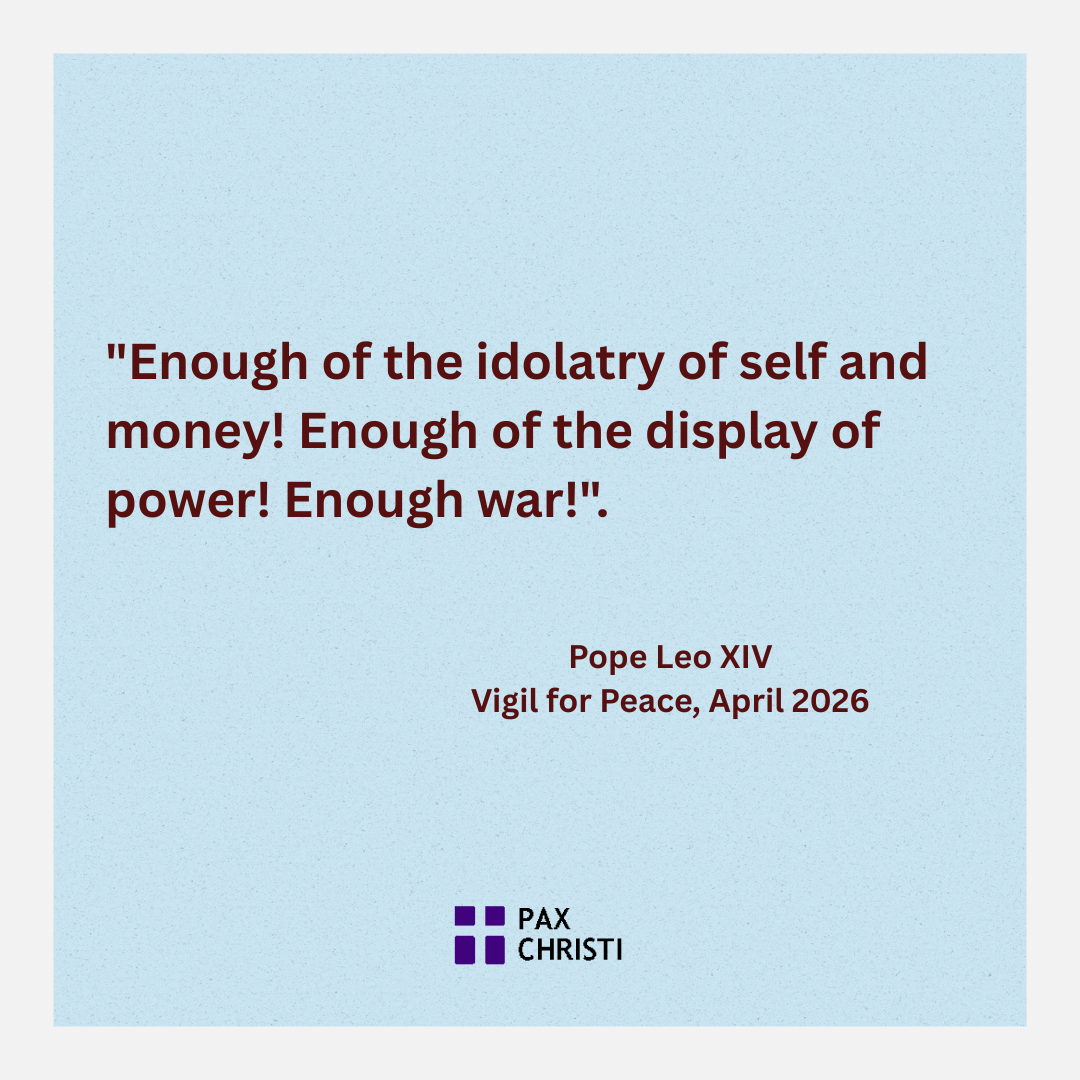
At the Prayer Vigil for Peace on the 11th April 11, Pope Leo XIV offered not a diplomatic appeal but a theologically charged intervention into a world marked by escalating tensions, destabilising rhetoric from global leaders, and the ongoing devastation faced by millions across the Middle East and beyond. Without naming names, his words unmistakably confront the logic of domination shaping contemporary political discourse.
“War divides; hope unites. Arrogance tramples upon others; love lifts up. Idolatry blinds us; the living God enlightens.” These antitheses are not merely rhetorical. They articulate a theological anthropology in which war is not a tragic inevitability but the fruit of disordered desire—what the Christian tradition names idolatry. Hence his uncompromising exhortation: “Enough of the idolatry of self and money! Enough of the display of power! Enough of war!”
Such language exposes the moral contradictions embedded in modern geopolitics. The normalization of violence, whether framed as deterrence, security, or national interest, reveals what the Pope calls a growing “delusion of omnipotence.” More gravely, it signals a theological distortion: “the holy Name of God…is being dragged into discourses of death.” Here, he decisively rejects any attempt to align the God of life with projects of destruction and death.
Central to his reflection is a retrieval of prayer as active, transformative praxis. “Prayer is not a refuge in which to hide from our responsibilities,” he insists. Rather, it is the space where “our limited human possibilities are joined to the infinite possibilities of God,” breaking what he names “the demonic cycle of evil.” Prayer, then, is not withdrawal but participation in God’s reconciling work, it is resistance to violence at its root.
From this theological foundation follows a direct political demand: “Stop! It is time for peace! Sit at the table of dialogue and mediation.” Yet responsibility is not confined to leaders. Violence persists not only through systemic violence and war, but through what he identifies as a “culture of enemies” perpetuated in everyday situations.
Particularly striking is his appeal to children in war zones, whose testimony reveals “all the horror and inhumanity” obscured by political justification. Their witness becomes a moral criterion, exposing the bankruptcy of narratives that sustain war.
“Nothing can confine us to a predetermined fate.” Against political fatalism and theological resignation, Pope Leo articulates an eschatological horizon in which peace is neither naïve nor optional. It is the concrete demand of a humanity called to conversion.
What difference does a prayer vigil make? The Pope answers plainly: “Prayer teaches us to act.” It disrupts our habituation to violence, our quiet complicity in what has been called the myth of redemptive violence, and reorientates thought, word, and deed toward the Kingdom of God: “a Kingdom in which there is no sword, no drone, no vengeance… but only dignity, understanding and forgiveness.”
The challenge, then, is unmistakable. If prayer forms us, it must also send us. Nonviolence is not an abstract ideal but a disciplined practice: refusing the language of enemies, resisting the seductions of power, confronting injustice and violence without mirroring its logic. In a world enthralled by domination, Pope Leo dares to name another possibility, not as aspiration, but as obligation. Peace is not someone else’s task, it is ours, enacted here and now through the risky, concrete work of peace-making and reconciliation.