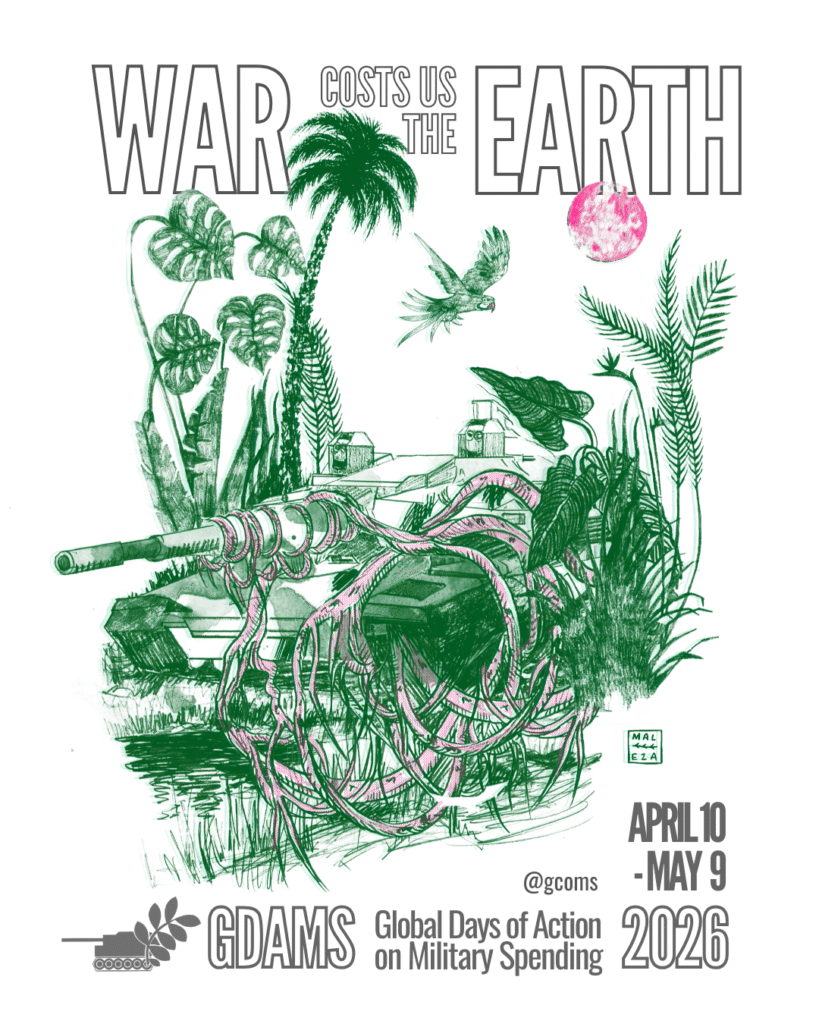
Global Days of Action on Military Spending 2026

We are in the middle of this year’s Global Days of Action on Military Spending and have signed this year’s international appeal.

The appeal challenges the narrative that increases in military spending increase our security and challenges Governments around the world to:

undertake major reductions to their military expenditure and redirect those funds to social and environmental sectors, tackling the global challenges of our time and funding human security’.

You can read the appeal in full here:

GDAMS 2026 Appeal

We are also one of the supporting organisations of Global Campaign on Military Spending UK and you can read the UK GDAMS 2026 appeal here:

GCOMS UK 2026 Appeal

The appeal calls for:

  • The UK government to cancel its proposals to increase spending on the military, specifically the plans to spend 3.5% of GDP during the next parliament.
  • The UK to focus on initiatives aimed at diplomacy, conflict reduction, and disarmament.
  • The highest priority to be given by the government to funding socially productive projects, including the alleviation of poverty and inequality at home and around the world, and stronger efforts to mitigate the climate and nature crises.
  • The UK to adhere to international law and the UN’s international conflict resolution framework, as well as compliance with disarmament treaties and support for the convening of a long-overdue Fourth Special Session on Disarmament, as agreed upon in the UN’s Pact for the Future.

Bamenda’s Witness: Nonviolence in an Upside-Down World

In Bamenda, Cameroon, a city marked by protracted conflict yet faithfully oriented toward reconciliation, Pope Leo XIV articulated a searing theological critique of violence dressed as order. This was not mere pastoral consolation; it was a radical reassertion of the Gospel’s nonviolent logic against the architects of war.

“I am here to proclaim peace,” he began, but immediately destabilized any passive reading of that claim. The locus of proclamation, he insisted, already resides among the people whose “feet” traverse a “bloodstained yet fertile land.” In classical prophetic cadence, he reframed suffering not as silence but as testimony, as witness.

His sharpest intervention targeted the idolatrous fusion of religion and power. Those who “manipulate religion and the very name of God for their own military, economic and political gain,” he warned, enact a form of theological desecration, instrumentalising transcendence for coercion. This is not simply corruption; it is blasphemy embedded in systems.

Equally incisive was his dismantling of the political economy of war. The so-called “masters of war,” he observed, deny an elementary moral truth: “it only takes a moment to destroy, yet often a lifetime is not enough to rebuild.” The allocation of “billions” to destruction, alongside the absence of resources for healing, reveals a global order structured against the Beatitudes.

He pressed further, implicating transnational extraction: wealth drawn from vulnerable lands is transmuted into weapons, perpetuating “an endless cycle of destabilization and death.” This “upside-down world” is, in theological terms, a disordered communion—creation turned against itself.

Against tyrants and billionaires who scandalous accumulation and control, the Pope advances a different eschatology: history bends not through domination, but through a disciplined, collective refusal to participate in violence. To those gathered Pope Leo declared; “Bamenda…you are the city on the hill.”

No more idols! No more war! A prophetic intervention from Pope Leo – Sr Katrina Alton

At the Prayer Vigil for Peace on the 11th April 11, Pope Leo XIV offered not a diplomatic appeal but a theologically charged intervention into a world marked by escalating tensions, destabilising rhetoric from global leaders, and the ongoing devastation faced by millions across the Middle East and beyond. Without naming names, his words unmistakably confront the logic of domination shaping contemporary political discourse.

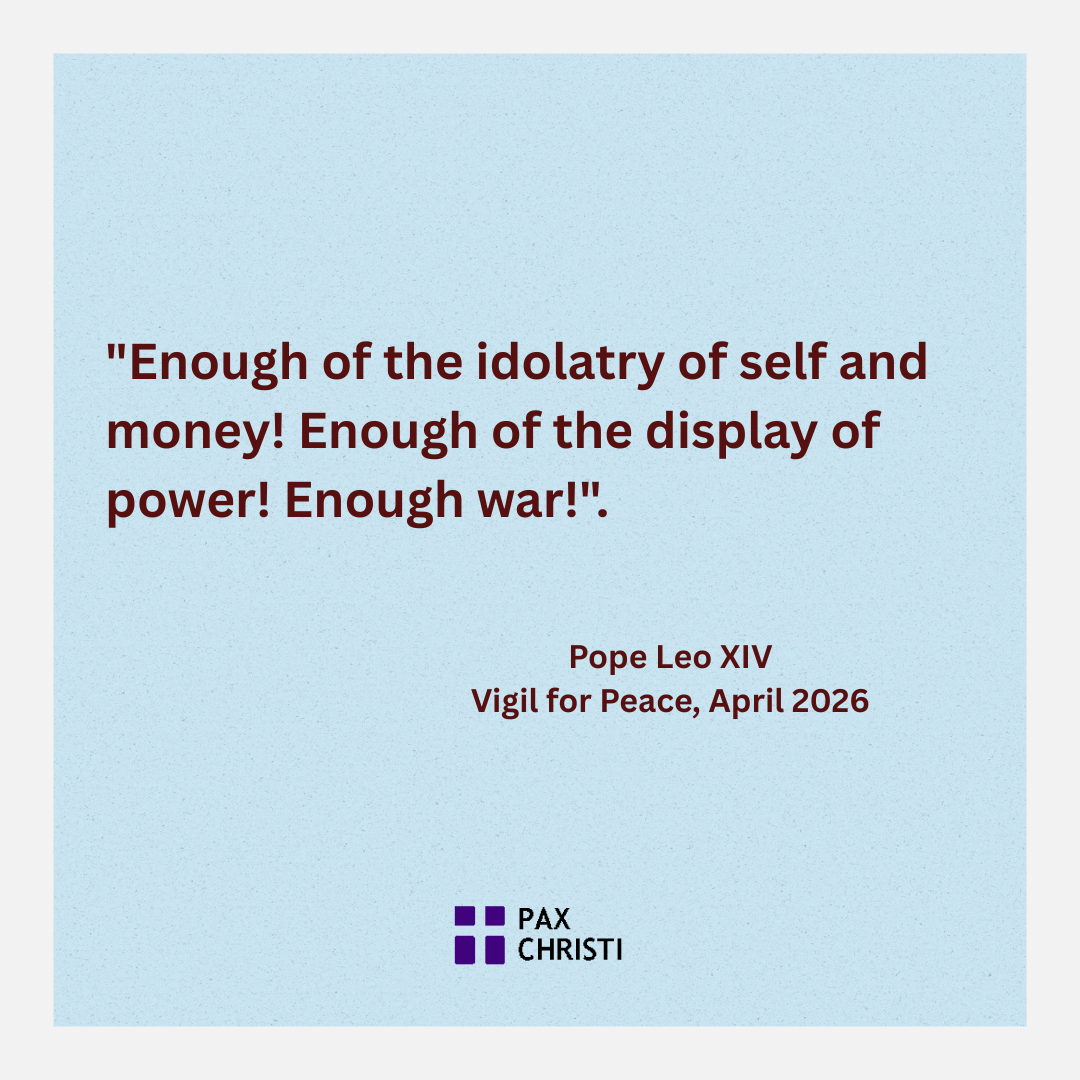
“War divides; hope unites. Arrogance tramples upon others; love lifts up. Idolatry blinds us; the living God enlightens.” These antitheses are not merely rhetorical. They articulate a theological anthropology in which war is not a tragic inevitability but the fruit of disordered desire—what the Christian tradition names idolatry. Hence his uncompromising exhortation: “Enough of the idolatry of self and money! Enough of the display of power! Enough of war!”

Such language exposes the moral contradictions embedded in modern geopolitics. The normalization of violence, whether framed as deterrence, security, or national interest, reveals what the Pope calls a growing “delusion of omnipotence.” More gravely, it signals a theological distortion: “the holy Name of God…is being dragged into discourses of death.” Here, he decisively rejects any attempt to align the God of life with projects of destruction and death.

Central to his reflection is a retrieval of prayer as active, transformative praxis. “Prayer is not a refuge in which to hide from our responsibilities,” he insists. Rather, it is the space where “our limited human possibilities are joined to the infinite possibilities of God,” breaking what he names “the demonic cycle of evil.” Prayer, then, is not withdrawal but participation in God’s reconciling work, it is resistance to violence at its root.

From this theological foundation follows a direct political demand: “Stop! It is time for peace! Sit at the table of dialogue and mediation.” Yet responsibility is not confined to leaders. Violence persists not only through systemic violence and war, but through what he identifies as a “culture of enemies” perpetuated in everyday situations.

Particularly striking is his appeal to children in war zones, whose testimony reveals “all the horror and inhumanity” obscured by political justification. Their witness becomes a moral criterion, exposing the bankruptcy of narratives that sustain war.

“Nothing can confine us to a predetermined fate.” Against political fatalism and theological resignation, Pope Leo articulates an eschatological horizon in which peace is neither naïve nor optional. It is the concrete demand of a humanity called to conversion.

What difference does a prayer vigil make? The Pope answers plainly: “Prayer teaches us to act.” It disrupts our habituation to violence, our quiet complicity in what has been called the myth of redemptive violence, and reorientates thought, word, and deed toward the Kingdom of God: “a Kingdom in which there is no sword, no drone, no vengeance… but only dignity, understanding and forgiveness.”

The challenge, then, is unmistakable. If prayer forms us, it must also send us. Nonviolence is not an abstract ideal but a disciplined practice: refusing the language of enemies, resisting the seductions of power, confronting injustice and violence without mirroring its logic. In a world enthralled by domination, Pope Leo dares to name another possibility, not as aspiration, but as obligation. Peace is not someone else’s task, it is ours, enacted here and now through the risky, concrete work of peace-making and reconciliation.

Stations of the Cross with a difference – Fr Joe Ryan

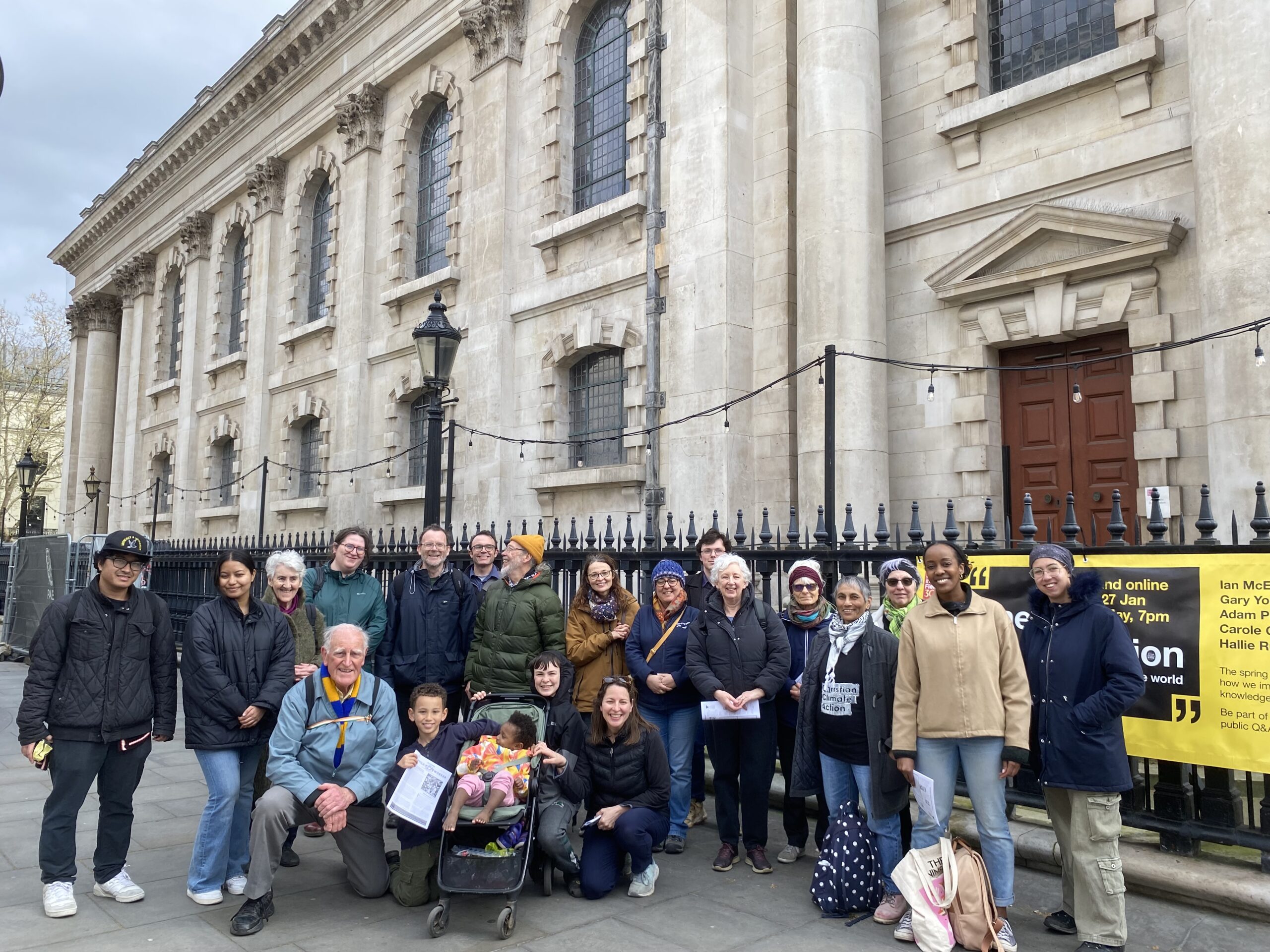
On Holy Saturday a different type of Stations of the Cross were organised by The Catholic Worker, Christian Climate Action, Christians for Palestine and Pax Christi.

We were in Central London visiting various sites; Government buildings, arms manufacturers headquarters; oil & gas companies, mining. companies and other historical sites built on the backs of extraction, slavery the destruction of our climate and the deaths of innocent people.

This was Holy Saturday, a time of waiting and prayer. We are in times of uncertainty in our world today. We are still reeling from the violence of Good Friday. That violence is still with us as people suffer today from war, starvation, greed, inhumanity to the vulnerable and injustices of all kinds.

We tried to meditate on how Jesus is still suffering today in the lives of so many children, women and men. 

At each location/station we remembered Jesus being condemned to death in a mock trial, taking up his cross, falling under that same burden, the consolation of Simon of Cyrene, Veronica and the Women of Jerusalem, the brutality of the Roman soldiers and Jesus nailed to the Cross. We tried to make that connection between the Suffering Christ and human suffering today.

We began at the Home Office, the place responsible for immigration control, security and order. It is also a place that strikes fear into many migrants, many of whom are waiting for decisions about whether they are safe to stay in the UK. Around 150,000 people are awaiting an asylum appeal decision, with a backlog of over 80,000 cases. This is all in the wake of rising hatred-filled rhetoric towards migrants with increasing hostility from the Home  Office and our Government.

We visited the former site of Rolls Royce and QinetiQ at Buckingham Gate. Here we were reminded of the manufacture of the Dreadnought nuclear armed ballistic missile submarines and the security they would supposedly bring us. But we know there are no winners in a nuclear war! In these buildings, the Ministry of Defence is orchestrating the continuing support for vital tests, training in warfare and evaluation in how to maximise the use of weapons of mass destruction.

At Parliament Square, opposite the Houses of Parliament, the centre of democratic power in our country, we reflected on  this scene where many people face arrest in protest of proscription of the group Palestine Action. This action, organised by Defend our Juries, has seen people from all walks of life put their freedom on the line.

At Trafalgar Square, we reflected on the Fourth Plinth; the work of the Mexican artist, Teresa Margolles. It depicts the faces of 726 trans, non-binary and gender non-conforming  people. the idea behind the art piece is rooted in its fragility; exposed to the elements, the faces will slowly disintegrate, showing how some people are marginalised out of existence.

We stood outside Dowing Street and nearby, the Department of Energy Security and Net  Zero and reflected on the Climate Crisis and all its implications.

We visited the Rio Tinto headquarters of the British-Australian mining multinational, responsible for the extraction of natural resources across the world; the BP buildings, one of the world largest companies with licences to extract oil and gas from Iraq, Nigeria, Venezuela and Libya. It shows how entangled the oil and gas industry is in the proliferation of war and genocide.

Finally, back to Trafalgar Square; Nelsons Column reminding us of Imperialism and the 19th century naval supremacy and colonial power giving rise to colonisation, slavery, supressing of indigenous communities and sheer greed supported by power. This exploitation is still very much alive today in the invasion of countries by so-called super powers. We see it day after day in our media.

Then we saw St Martin-in-the fields, a beacon of light and support for the homeless; a place of prayer and musical celebrations lifting the human spirit,  just like the National Gallery celebrating art and human dignity in our troubled world.

These Saturday Stations and reflections have been very powerful and also very challenging. We have to live in the real world and bring to life the reality of the suffering Jesus today. We have to identify and see the face of Jesus on those who suffer; we have to protect God’s creation and yet not hinder development and human growth. It’s like walking a tightrope.

I was so glad to have the opportunity to join with others in that exercise.

Joe Ryan

Lebanon: The Real War and the War of Words – Ian Linden

“The abuse and manipulation of God’s name to justify this and any other war is the gravest sin we can commit at the present time”.
 Cardinal Pierbattista Pizzaballa, Patriarch of Jerusalem, 17 March 2026.

What do Peter Hegsmith, US Secretary of Defence, Naim Qassem, secretary-General of Hezbollah, and Itamar Ben-Gvir, Israeli Minister of National Security, have in common?  They all believe that military force is there to fulfill their version of God’s will.  Deus Vult, God Wills it. That their use of force does not conform to the laws of war does not seem to bother them.  Their own might is always right because it has a divine purpose whether inspired by Christian nationalism, extreme forms of Islamist thinking or Zionist Judaism. 

Modern warfare  has become an exercise in increasing the distance between those perpetrating the killing and the reality on the ground ‘Collateral damage’ sounds like storm damage – to a building.  But those words frequently indicate dead and maimed children, women and other non-combatants.  Political leaders, military chiefs and nuclear scientists,  called ‘high value targets’,  are “taken out”, not assassinated.  With them often die their wives, children, and friends; it has been reported that Israel calibrates the number deemed acceptable against the estimated importance of each target.  ‘States have “capabilities”: the vast array of technical resources capable of overwhelming an enemy not their capacity to resolve conflict diplomatically.  Vague euphemisms, the ‘cuttlefish ink’ Orwell described  in his 1946 essay “Politics and the English Language”, are spurted out daily trying to obscure what television news reveals thanks to courageous war correspondents. 

At the opposite pole from military euphemism is the word ‘terrorist’, covering a multitude of sins.  The once functional definition of terrorism – violent actions by a sub-state actor to achieve political goals by instilling fear in communities is increasingly inadequate.   States themselves can, and do, terrorise their citizens.  Iran is an obvious example.  Sub-state actors become a part of a government, or at some point take over the State itself.  If terrorism simply means violence to achieve political aims there is no moral reason not to accuse brutal States of ‘terrorism’   Madeleine Albright, US Secretary of State under President Bill Clinton 1997-2001 pointed out – at a later date – that the United States has often had “limited success when declaring war against nouns”.

Slovenly use of language creates a pernicious loop with what Orwell called ‘foolish thoughts’ and with what we today call ‘spin’.  This loop characterises the arsenal of disinformation and propaganda used to quieten citizens’ moral concerns about today’s wars.  Had he not been a “Christian atheist” confronted by totalitarianism, Orwell might have added how misuse of language and poor theology links to ‘foolish thoughts’ about war and God’s will.  Christian nationalists are a good example.

Just war theory, both Islamic and Christianmakes the distinction between combatants and non-combatants.  But the nature of today’s weapons,  modern warfare, the relationships within civil society created by Islamist dispensations, or implanted in other religious communities by propagandists, makes distinguishing actual combatants more difficult.  Today’s war in the Lebanon makes it almost impossible.   If a war is God’s Will, it seems, the Divine Will overrides moral restraints.

Trump and his circle convince themselves with their own misleading language.  Given the information available to his Intelligence agencies, the US Administration’s misconception about  likely reaction to their attack on Iran is startling.   Iran obviously had been long preparing for war and would prove a resolute opponent, drawing in Hezbollah, yet the White House didn’t anticipate blocking of the Straits of Hormuz.

Hezbollah’s origins lie in the war between Israel and the Palestinians and Israel’s 1978 and 1982 invasions of Lebanon targeting refugees and the Palestine Liberation Organisation’s (PLO) militia.  Lebanon had fallen apart into a civil war between ten different religious communities and their militias, segregated along sectarian lines. 

Export of its 1979 Islamic revolution was the foreign policy of the Islamic Republic of Iran lead by Ayatollah Khomenei Hezbollah initially saw itself as an integral part of this new dispensation.  In 1983 it placed bombs by the US embassy and marine barracks killing 241 Americans.   The Ta’if Agreement mediated by Saudi Arabia and brokered by the Arab League, designed to end Lebanon’s civil war, was signed in 1989:  Hezbollah was recognised as the sole militia responsible for future resistance. 

Modelled on IranHezbollah created a multi-layered pyramidal structure for governance: a Majlis Shura al-Qarar, a consultative council of seven primarily clerical members, Sheik Naim Qassem amongst them, elected every three years by a convention of some 250 Hezbollah top cadres.  There are executive, political, judicial, jihad/security and the parliamentary work, councils. By 1992 Ayatollah Khamenei, successor to Khomenei, was recommending Hezbollah adopt a policy of Infitah: participation  in Lebanon’s elections.   They maintain on average ten deputies in Lebanon’s parliament and are guaranteed two Government Ministers.

According to Joseph Daher’s Hezbollah: The Political Economy of Lebanon’s Party of God, Pluto Press 2016, Hezbollah developed organisations for health, education, seminary training,  orphans, and emergency aid.  Islam compliant loans, zakat tithing, donations and discount cards aided the poor.  An extensive education system plus a TV network, radio station and publishing outlets inculcated the principal of Iltizam, religious commitment and adherence to strict Islamist practice including the duty of supporting Hezbollah. 

Houses were rebuilt after bombing raids honouring the slogan ‘reconstruction, resistance and rebirth’.  Disciplined lives became prosperous lives; a Shi’a middle class grew. The vision was a pure society uncorrupted by the West, an Islamic milieu, hala islamiyya, a ‘resistance society’ against the Zionist enemy. The provision of public services and charitable outreach, a  ‘combination of consent and coercion’, in Daher’s words, encouraged Lebanese Shi’a acceptance of Hezbollah’s authority. 

Southern Lebanon, predominantly Shi’a, dotted with small towns with some ancient Christian villages, now under Israeli attack, has an agricultural economy.   Its people are farmers plus well-off entrepreneurs, landowners and Hezbollah local government officials.  There are possibly 60,000 fighters including part-time reservists and a UN peacekeeping force reduced to 7,500 mandated to secure a buffer zone south of the Litani river.   A significant Shi’a community lives in the more mixed northern Beqaa Valley.

It is easy, especially in war time, to interpret attempts to understand a party to a conflict as support for that party.   Support is clearly not the intention of Daher’s Hezbollah.   Nor is it mine.  But for several reasons, including future negotiations, ignorance is not bliss as  the Middle East today demonstrates.
With its armed wing, trained by the Iran’s Islamic Revolutionary Guard Corps (IRGC), Hezbollah poses an intractable problem for Lebanon’s army and government.  Its rocket attacks provide Israel with their perennial justification for prolonged invasions of Lebanon and the bombing of “Hezbollah strongholds”.  Over one million people, 18% of Lebanon’s population, have had to abandon their homes as the invading Israeli Defence Force (IDF) pushes further into the South again.  In Dahieh, a densely populated southern suburb of Beirut,  controlled by Hezbollah residents cannot easily be sorted into combatants and non-combatants.  Bombs hit buildings which collapse burying people under rubble In Dahieh as in Gaza  The death toll is already above 1,000, 10% children. 

An infinite gulf exists between the Will of a loving, merciful and compassionate God and the will to power that States, and non-state actors, exert in war.  It cannot be bridged – least of all by euphemistic language, ignorance and disinformation.  On his right biceps, Peter Hegseth has a Deus Vult tattoo.  A  chant from the First Crusade, it marks the clear and present danger of Christian Nationalism.