St Oscar Romero and the Lenten Way of Nonviolence

Image: Portrait of St Oscar Romero by Luis Del Valle Peralta, commissioned by Christina Cox and the National Museum of Catholic Art and Library in honour of his Canonisation.

On March 24, the Church commemorates the martyrdom of Bishop Oscar Romero, canonized as Saint Oscar Romero, a pastor whose life and death embodied the power of Gospel nonviolence. Assassinated while celebrating Mass in 1980, Romero’s witness continues to challenge a world addicted to violence, retaliation, and indifference.

Romero did not begin as a radical peacemaker. Appointed Archbishop of San Salvador amid growing repression in El Salvador, he was initially considered cautious. Seeing the suffering of peasants, labourers, catechists, and priests targeted by state violence, converted his heart more deeply to the radical demands of the Gospel. Grounded in prayer and the Eucharist, he came to see that fidelity to Jesus meant standing unarmed before the machinery of death.

“I would like to make an appeal in a special way to the men of the army,” he preached the day before he was killed. “In the name of God, then, and in the name of this suffering people… I beg you, I implore you, I order you in the name of God: stop the repression!” His words were a call to a conversion of heart, to the way of the nonviolent Jesus. Romero believed that violence deforms both victim and perpetrator; only truth, justice, and love can heal a nation.

For Romero, nonviolence was not passivity. It was active, courageous discipleship shaped by the Sermon on the Mount. “The church,” he insisted, “would betray its own love for God and its fidelity to the Gospel if it stopped being… the defender of the rights of the poor.” To defend the poor without taking up arms required a fierce trust that God’s justice outlasts every regime. “If they kill me, I shall rise again in the Salvadoran people,”. A true expression of Easter hope in the face of Good Friday brutality.

Romero’s martyrdom at the altar revealed the logic of Gospel nonviolence: the shepherd lays down his life rather than take another’s. Decades later, his voice still resounds wherever Christians confront oppression without hatred or violence.

On this anniversary, his life asks us whether we will mirror the world’s violence, or the way of nonviolent love revealed in the life, death, and resurrection of Jesus. In remembering Romero, we trust that nonviolence is not weakness; it is the boldest proclamation that God’s reign comes not by the sword, but by nonviolent love.
St Joseph and the Subversive Power of Tenderness

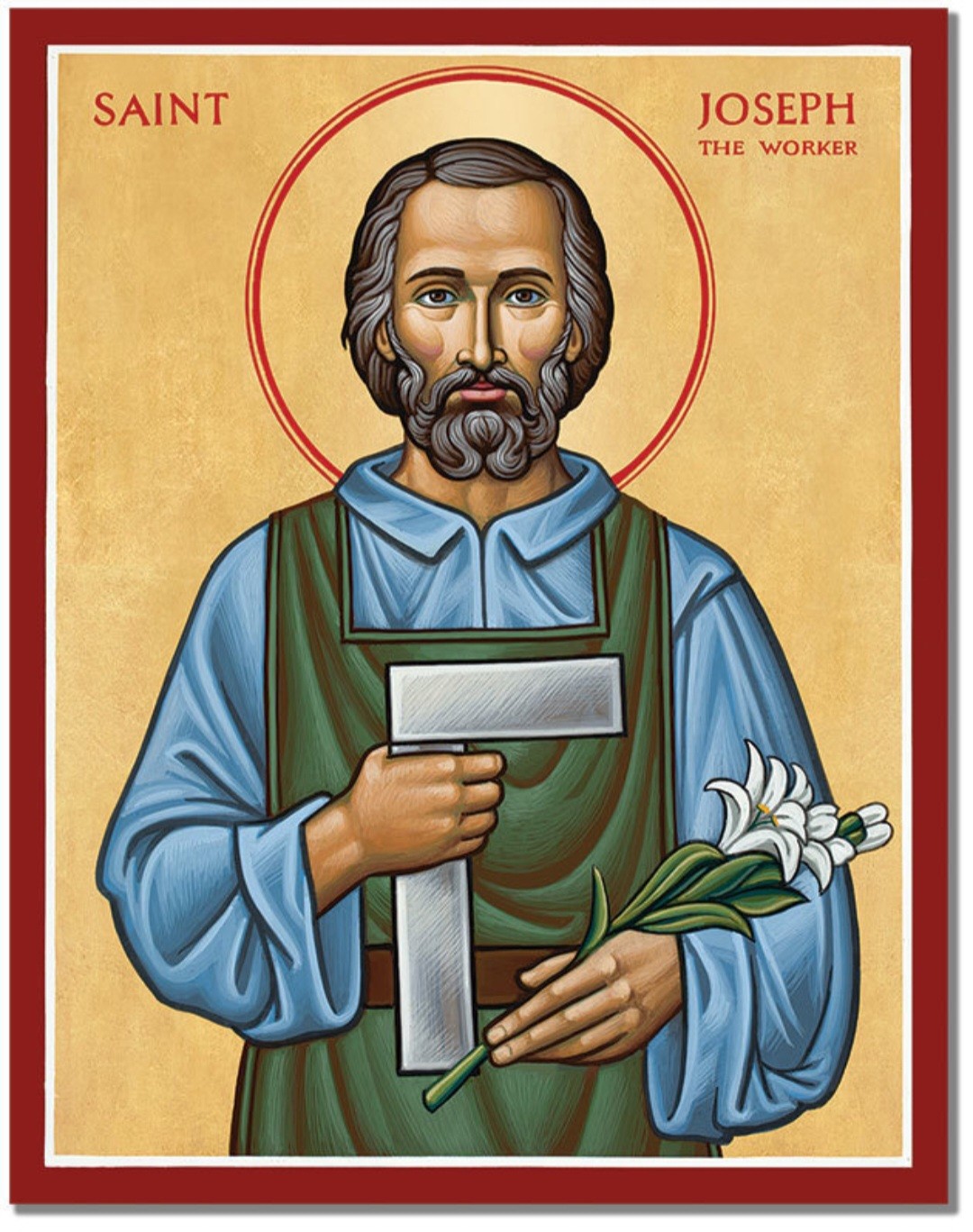
Image: Icon of St.Joseph written by Brother Simeon Davis for Monastery Icons

In the middle of Lent, March 19th, the Church interrupts its journey toward the Cross to remember a man who never speaks a word in the Gospels. Yet the quiet life of St Joseph may be one of the most radical testimonies to Gospel nonviolence in all of Scripture.

Joseph is not a prophet, priest, or preacher. He is a working man whose holiness is revealed in the small, dangerous decisions of everyday life. In a world obsessed with honour, control, and reputation, Joseph chooses nonviolent love.

The Gospel tells us that when Joseph discovered Mary’s unexpected pregnancy, he resolved to divorce her quietly. Under the social codes of the time, he could have exposed her to humiliation, violence, even death. Instead, Joseph refuses to weaponize the law. Even before the angel appears in a dream, he leans toward compassion. His silence is not weakness. It is resistance.

Joseph’s life continues as a series of disruptive calls from God. In the middle of the night, he rises to protect Mary and the child Jesus, fleeing the machinery of imperial violence unleashed by Herod. The Holy Family becomes a refugee family, crossing borders and surviving on the margins in Egypt. His nonviolence is not sentimental. It is practical, embodied, and risky.

Lent asks us hard questions:
How do we respond to fear?
What do we do when power threatens the vulnerable?
Do we reach for control, retaliation, and self-protection, or do we choose the costly path of nonviolent love?

Joseph shows us another way. His vocation as husband and father is expressed not through authority but through service, anticipating the servant leadership that Jesus will later proclaim and embody.

In recent years, Pope Francis has spoken of a “revolution of tenderness.” Joseph embodies that revolution as an antidote to the rise of ‘toxic masculinity’ in our culture.

As we journey through Lent toward the Cross, Joseph reminds us that nonviolence begins in the heart. It begins in the refusal to shame, to dominate, to retaliate. It begins with the daily decision to protect rather than wound, to trust rather than control, and to love without calculating the cost.

That may look small in the eyes of the world. But in the Gospel, it is revolutionary!

Sr Katrina Alton, National Chaplain to Pax Christi E&W

Nonviolence: A Radical Alternative

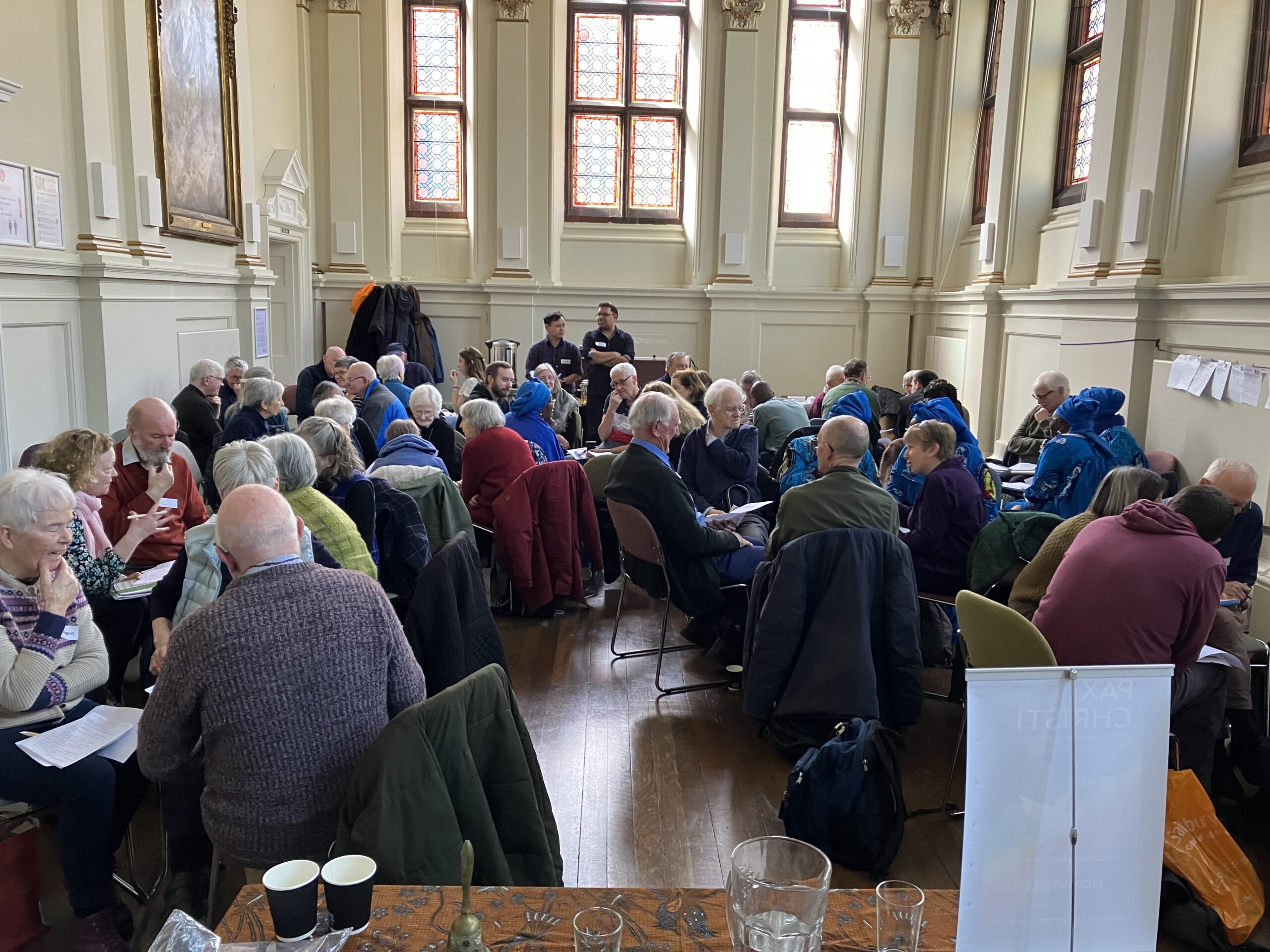
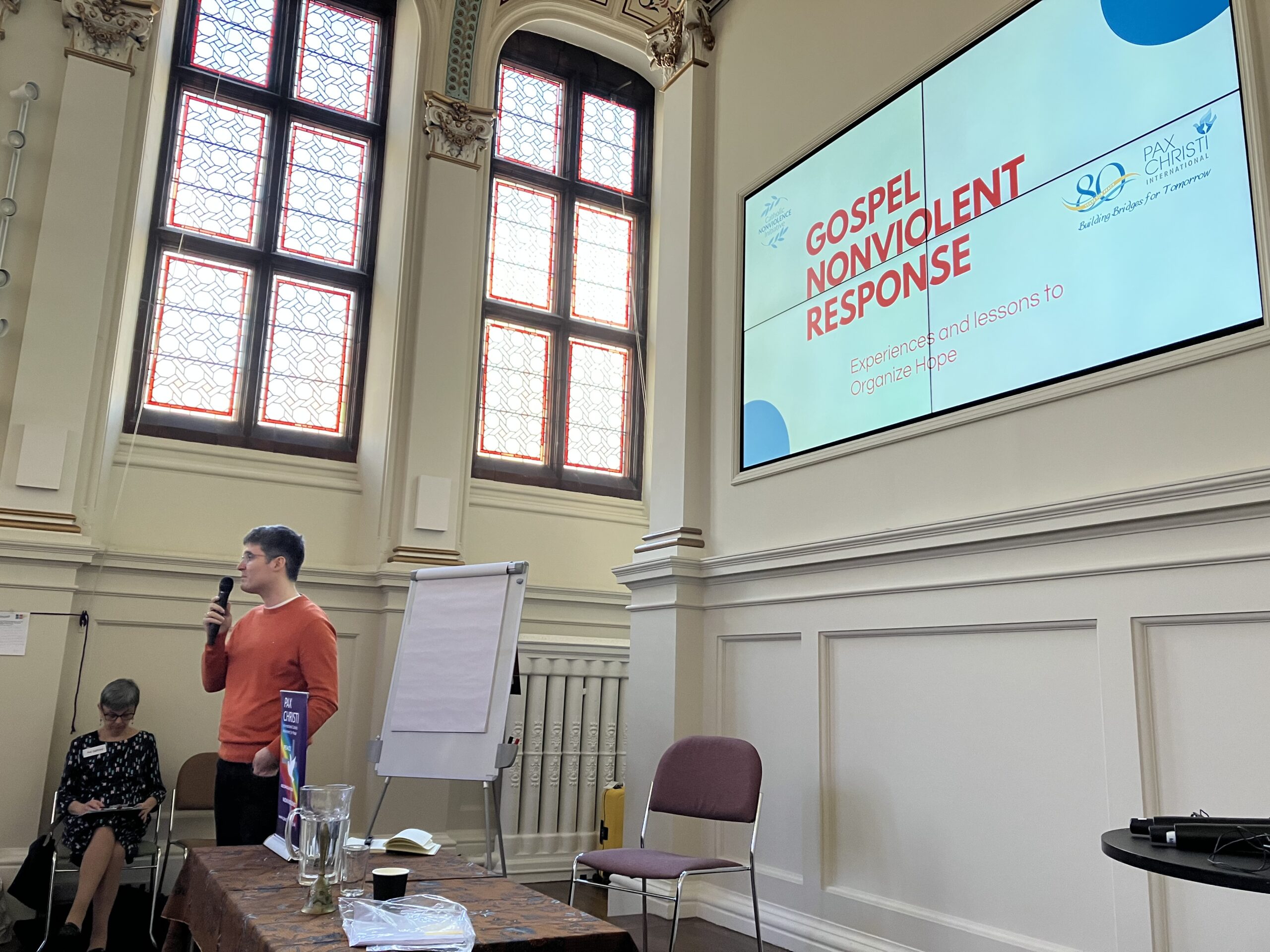
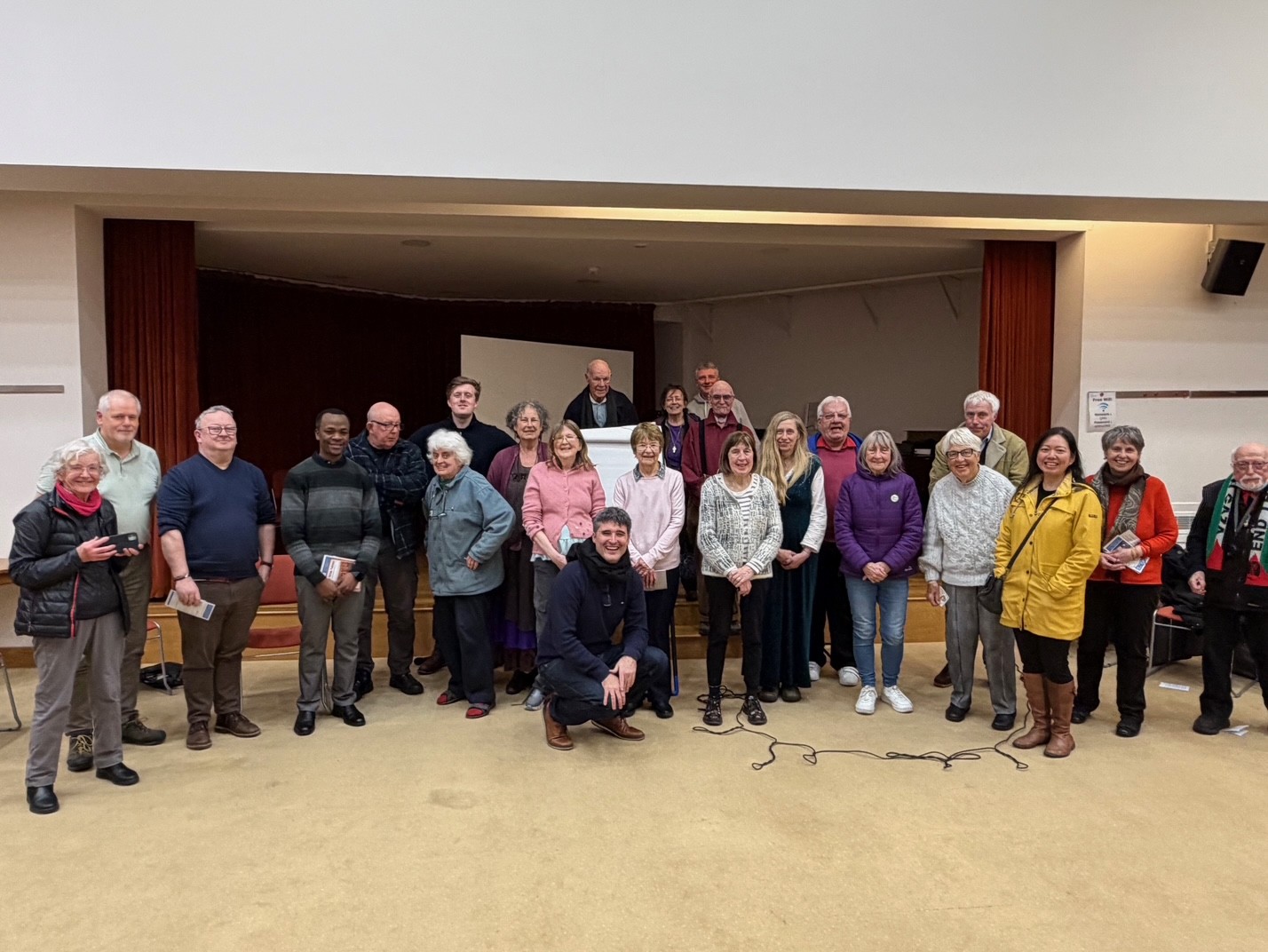
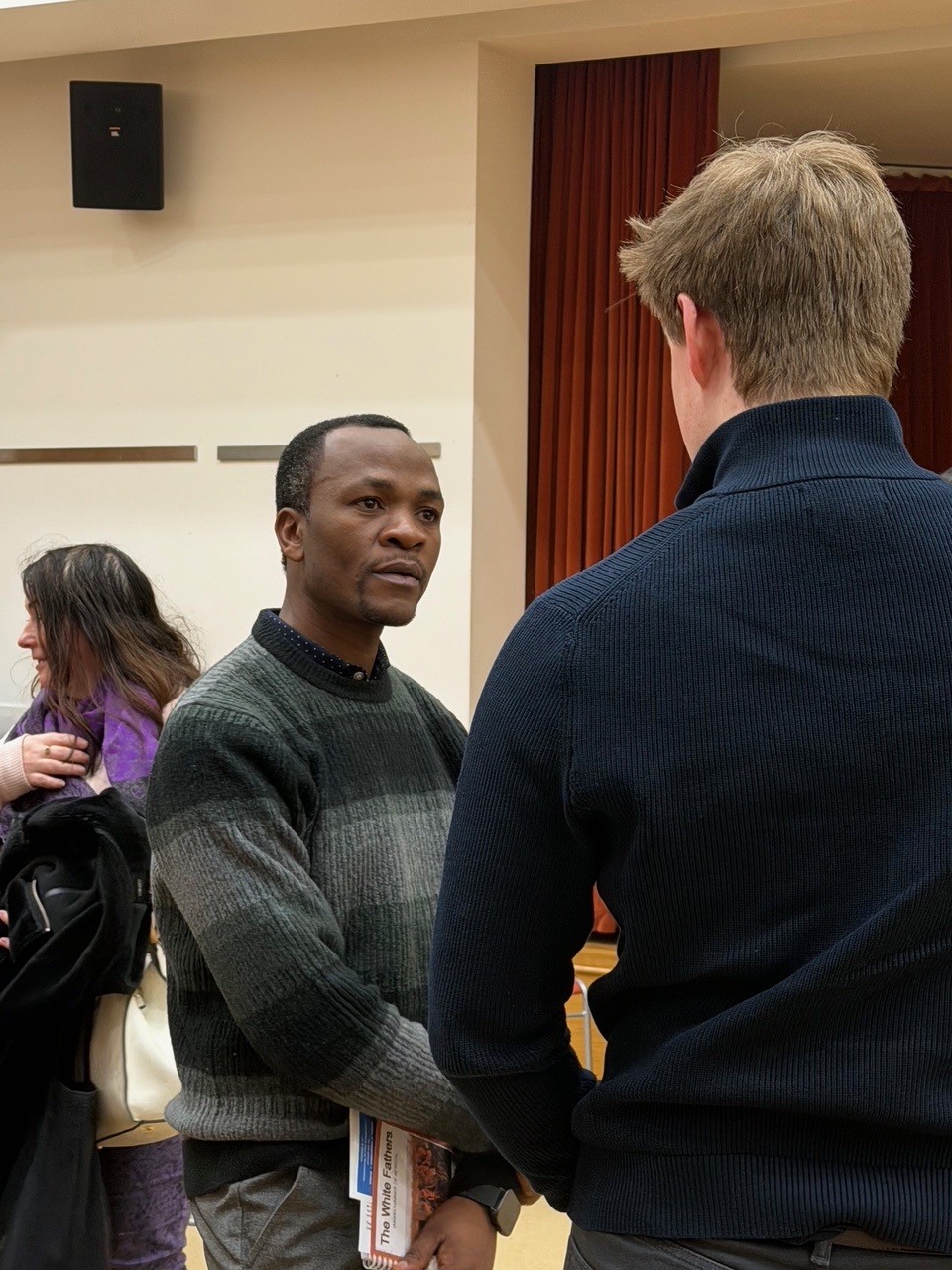
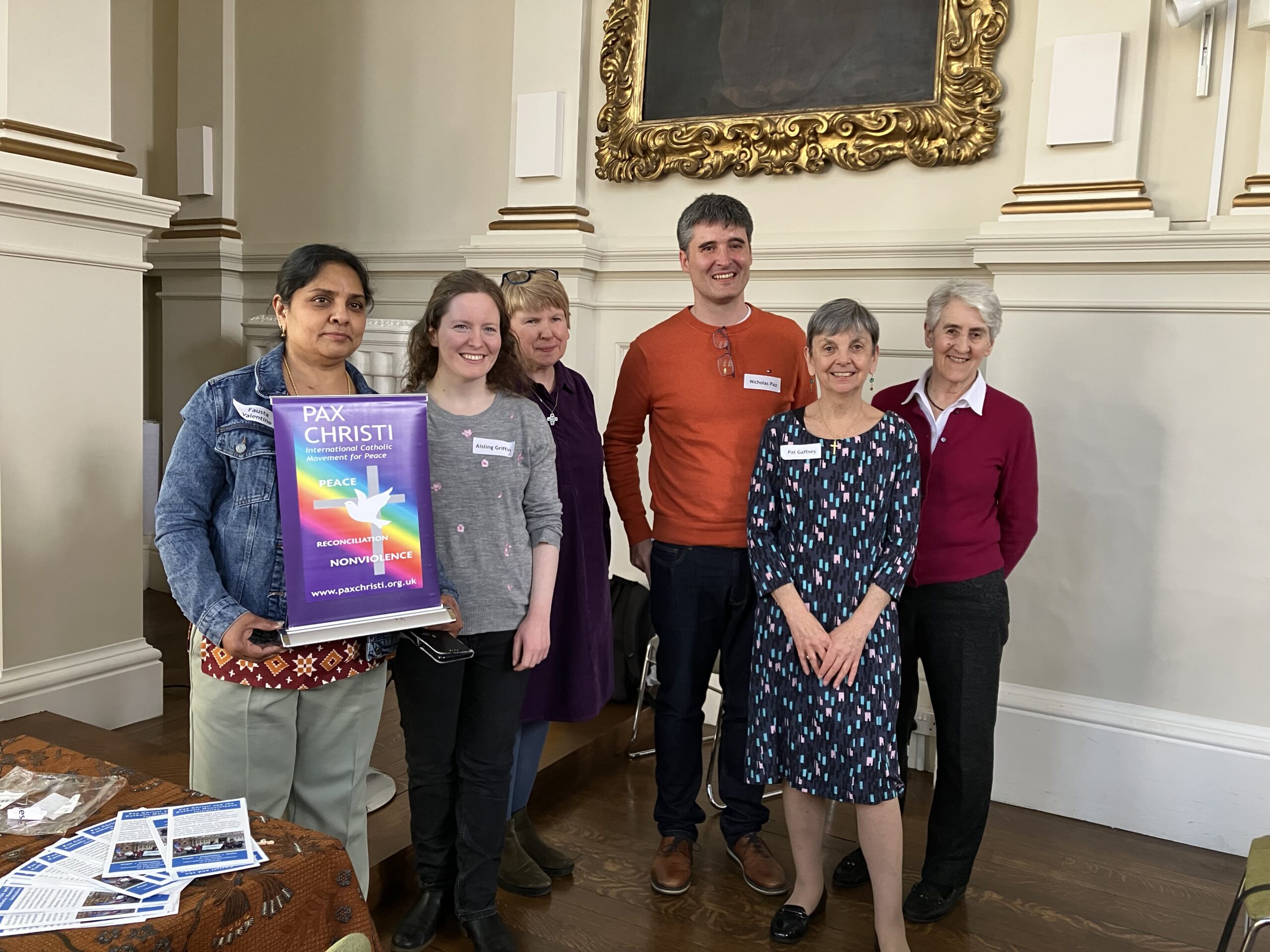
We had a great weekend with Nicholas Paz from the Catholic Nonviolence Initiative meeting with a number of Bishops on Friday and then speaking at events in London, Leeds and Liverpool. Thank you to everyone who joined us and to Nicholas for your input and inspiration.

Here are just some of the comments from those who attended:

Nonviolence ‘is much broader than ‘pacifism’, disarmament etc. It is a spirituality above all’.

‘Good to hear about the recent research on effectiveness of nonviolence and the different ways of presenting the idea to a Catholic audience’

Nicholas explained ‘the interconnectedness of the varied manifestations of violence: personal, community and international’.

I learned that ‘nonviolence is not about submission. Nonviolence should say NO to what is wrong.’

One of our former Vice Chairs, Joan Sharples has written a longer reflection on the event in Liverpool which you can read as a Members’ Blog here:

Reflections on Nonviolence – Joan Sharples

As part of a national tour, Nicholas Paz, director of the Catholic Nonviolence Initiative, led an evening session in Liverpool. In a brief introduction he described his own journey from research work to work in mediation. It was encouraging to hear him assert that nonviolence is recognised as an academic field and that there is hard evidence that nonviolence achieves goals faster and more effectively than through violent methods. 

For Nicholas, however, nonviolence was predominantly a spirituality, a deep call to live the nonviolent way of Jesus.

Nicholas invited the thirty people present to name a conflict of concern to them in their life. A rich sharing ensued as people named: personal issues: ‘my own anger’; family situations: ‘my grandchildren struggling with being bullied at school’; community tensions: ‘demonising migrants’; and the global context: ‘world news is too horrifying to watch’.  This process took a long time. Watching Nicholas listen with great attention to each contribution was a lesson in itself.

Nicholas affirmed what had been said, commenting, ‘This is what we are living: violence starts when we don’t take time to listen to each other’. He suggested that we need to acknowledge our own violence as the first step and to work in community with others, reminding us that conflict and violence are not the same and that conflict can be addressed nonviolently. He gave us a tool-box of four words; perception, narrative, space and time.

Perception is the way each person perceives reality. It is not fact. 

We can describe a narrative with closed language: always, never… , but open language: maybe, perhaps…is more effective at promoting dialogue and disarming violence.

Space is important, whether it is the way one sits in a chair; the layout of a room; the planning of the city… Space conditions behaviour.

Understanding and nonviolence work takes time and requires sitting together.

Unfortunately – and ironically – that was when I had to leave for my train. I would like to have listened a lot longer to Nicholas – and I would have liked to pursue conversations with some of the others in the room who had brought to the space such important real-life concerns. 

How the works of God are displayed – Paul Mcgowan

Only once has a UK local authority pension fund divested in any way from the arms trade. This is how it happened and how St John’s gospel unwittingly described it.

In chapter 9 of his Gospel, which we read at Mass yesterday, St John tells a story about wilful blindness, prevarication, obfuscation, real blindness and curing.

As he went along, he saw a man who had been blind from birth. His disciples asked him ‘Rabbi, who sinned, this man or his parents, for him to have been born blind?’  

The man had been blind for twenty, maybe thirty, years. It was his natural condition. It would continue until he died. Cluster bombs came into being around 1940 and were not formally outlawed until 2008. The UK ratified the ban into law in 2010. Seventy years, it took – a lifetime.

‘Neither he nor his parents sinned’, Jesus answered, ‘he was born blind so that the works of God might be displayed in him’.

Jesus rejects the disciples’ viewpoint. The blind man’s situation is not to be endured. The situation needs to be understood in a different way. The 2010 Convention on Cluster Munitions (CCW) was also a declaration that a new way had been reached. But declarations are not enough; they must be acted on. And Jesus insists on making a public display of the unfolding of God’s works. In 2014, we discovered that cluster munitions were still being funded by our local pension fund, despite having been illegal in the UK since 2010. The mere declaration of these facts ought to have been enough to end the funding. Or, as the man born blind summarised things, ‘The fact is: I used to be blind, but now I can see.’ 

Then some of the Pharisees said: ‘This man cannot be from God; he does not keep the Sabbath.’

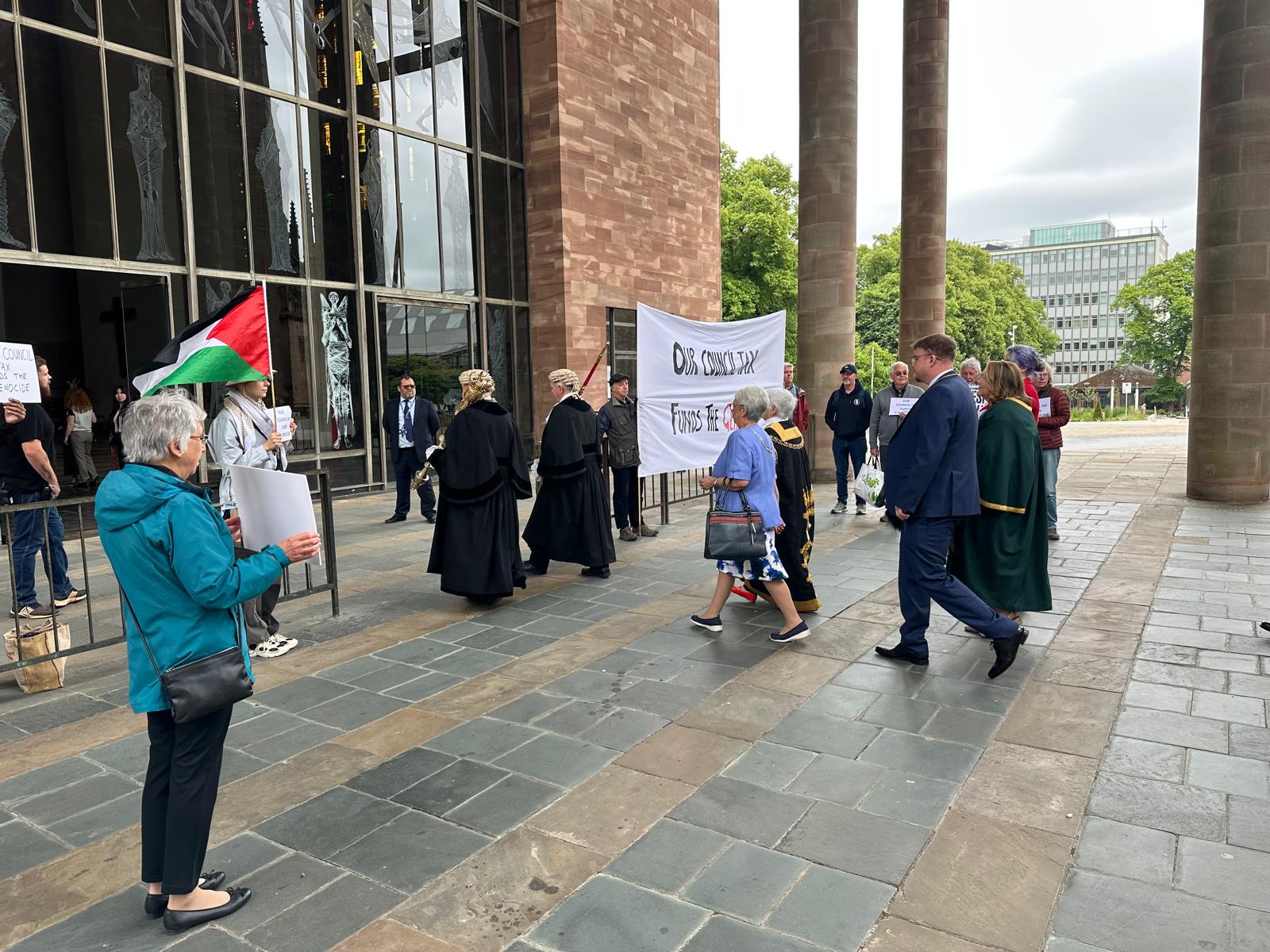
 And so, throughout 2014, 2015 and 2016 a tiny handful of citizens protested. They went about the streets, they stood outside cathedrals, they argued with all and sundry. But they found reasons to reject the truth.

I have told you once already and you wouldn’t listen. Why do you want to hear it all again?

And then, in 2017 they found a Councillor who believed the evidence they brought.

It is for judgement that I have come into this world, so that those without sight may see.

And when he spoke bravely to his colleagues, some also believed and he pressed them until they ended the funding. But there was a sting in the tail, just as there is in St John’s story. Because, you see, others thought they could just reduce the funding and pretend that they had done the right thing. They claimed to have seen the truth, but their guilt remained, and they deceived the one honest man who truly believed.

(Councillor JM died in 2022. God rest his soul.)

16th March 2026