Five years of the Treaty on the Prohibition of Nuclear Weapons

The 22nd January was the 5th Anniversary of the Treaty on the Prohibition of Nuclear Weapons coming into force.

This landmark Treaty imposed a comprehensive ban on nuclear weapons, making it illegal to (amongst other things) develop, possess, use or threaten to use them. A total of 74 states have now ratified or acceded to the Treaty and a further 25 States have signed the Treaty but are yet to ratify it. There is a growing majority bringing moral pressure on the nuclear armed states, including the UK, to make much greater progress on nuclear disarmament.

The Catholic Church supports the Treaty and its aims. The Holy See signed the Treaty on the day it was opened for signature. Both Pope Francis and Pope Leo have confirmed that Catholic teaching requires disarmament and a world free of nuclear weapons. Pope Francis said that it is not just the use of nuclear weapons that is immoral but ‘their very possession’. In his message for the World Day of Peace (the message we reflected on for Peace Sunday last weekend), Pope Leo said ‘The idea of the deterrent power of military might, especially nuclear deterrence, is based on the irrationality of relations between nations, built not on law, justice and trust, but on fear and domination by force’.

The UK’s approach to the TPNW has been recalcitrant, constantly refusing to engage with the Treaty processes whilst at the same time failing to fulfil its obligations as a party to the Nuclear Proliferation Treaty – the treaty which it claims is the only route to nuclear disarmament.

As we mark the 5th anniversary of the TPNW, we confirm that, in the words of the Catholic Bishops’ Conference (England and Wales) in ‘Called to be Peacemakers’, we continue in ‘prayer and public witness’ to campaign for the UK to sign and ratify the Treaty and, until they do, engage meaningfully with the treaty framework, not least in participating as an observer in future meetings of signatories.

Take Action on Nuclear Weapons

If you would like to be involved in our campaigns on Nuclear Weapons, why not join other members and supporters in our Disarmament Working Group ? For more detail, contact us on info@paxchristi.org.uk

Also have a look at our calendar of events where you will find details of a number of upcoming webinars on nuclear weapons themes.

And why not read this short article by Jonathan Frerichs, Pax Christi International Main Representative at UN Geneva:

Half the world’s countries are united in new Nuclear Ban Treaty

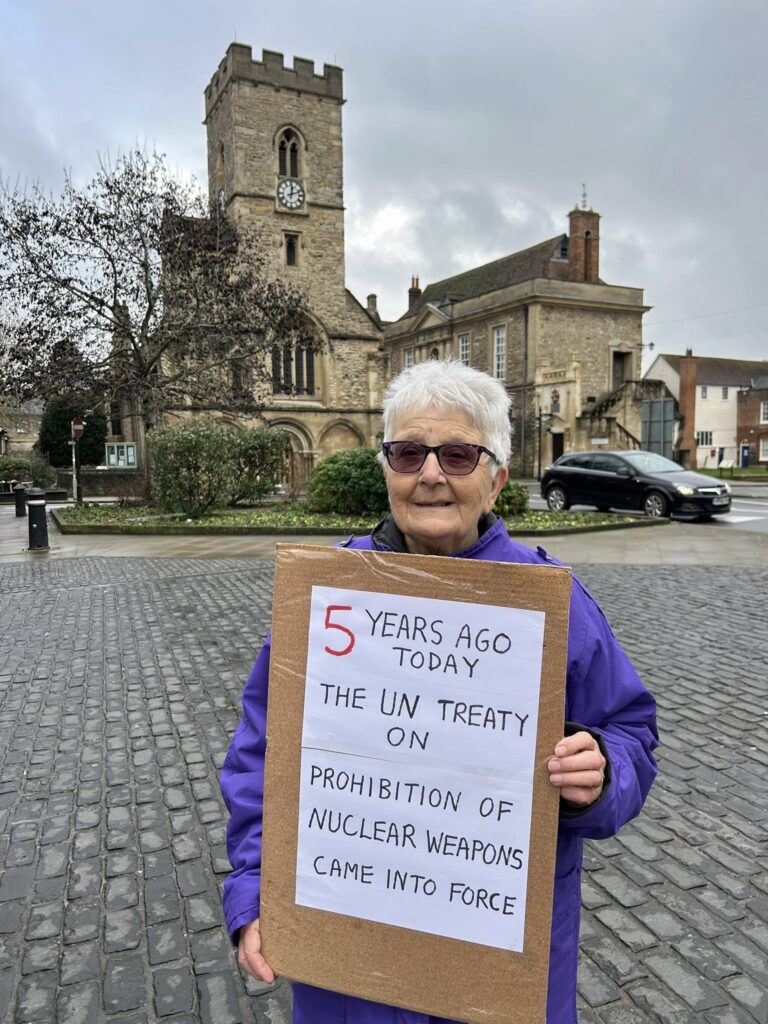
Image: Former Vice President and Pax Christi Member Ann Dodd marking the 5th anniversary of the TPNW with Abingdon Peace Group

A meeting of hope – Martin Birdseye

Being more involved with ICAN UK recently, (as Pax Christi’s regular representative) I seized the opportunity to attend a meeting with Melissa Parke, Executive Director of ICAN.  Melissa was in London last week for meetings with MPs and made time for a short in‑person meeting with ICAN UK supporters. 

Not many were present because of short notice but there was a sufficient variety of people to generate an inspiring round-table discussion.

What could have been not much different from an ordinary meeting of ICAN UK supporters, was transformed by having to introduce ourselves and our projects to Melissa, leader of the global ICAN project to abolish nuclear weapons!    The marvellous variety, vision and long-term perseverance of UK campaigning became very apparent.

Having explained my connections with Christian CND and Pax Christi I outlined the ideas and origins of the You Decide nuclear morality flowchart project.  I find that the value of the ethical approach in promoting disarmament is now much better understood (probably since the TPNW and its “ethical imperatives…”) so it’s much easier to explain a logical decide-for-yourself approach to resolving the morality of nuclear deterrence.  Jude Madubuike, now leader of the project, then went on to explain how it is now established as the You Decide CIC, moving ahead and looking for new resources.  We were encouraged by the positive response in this illustrious company.

Melissa briefed us on some latest concerns, and campaign policy.  AI now escalates war scenarios: because while final decisions can be reserved for human intervention, many of the inputs to decision will be generated by AI.  The New Start Treaty is now lapsed.  We have to move the world on from just arms control to disarmament.  Nuclear deterrence must be seen for what it is, the ultimate form of terrorism.  Meanwhile ICAN is working on a platform that will enable more collaborative work among the ICAN partner organisations.  This is work in progress. (We are planning for You Decide to be registered as an ICAN partner organisation.)

A strong theme in discussion was hope.  We have to wake people up but avoid alarmist panic and despair.  Support for abolition depends on a belief that it can be done.

Indeed it can!  Look to the TPNW!

Martin Birdseye

15th February 2026

http://nuclearmorality.com/

https://www.icanw.org/melissa_parke

Ash Wednesday, Repentance and A Disarming Peace – Sr Katrina Alton

Ash Wednesday confronts the Church with an unambiguous anthropological truth: “You are dust, and to dust you shall return.” The liturgy dismantles fantasies of permanence and control, situating human life within its proper limits before God.

It is from this starting point that Pope Leo’s 2026 World Day Peace message, “Peace be with you all: Towards an ‘unarmed and disarming’ peace,” must be read. The message is not a technical policy proposal but a theological reorientation. It directly challenges the reigning security logic of our age, especially the moral legitimacy granted to nuclear “deterrence”. The claim that peace can be preserved through the credible threat of mass annihilation stands in stark tension with Christian ethics and with the Gospel’s revelation of salvation.

The Ash Wednesday readings sharpen this tension. Joel’s command to “rend your hearts, not your garments” (Joel 2:13) exposes religious gestures that leave unjust structures untouched. Psalm 51 gives voice to repentance stripped of self-justification, naming sin as a rupture in right relationship with God and neighbour. Paul’s urgent declaration— “now is the acceptable time” (2 Cor 6:2)—eliminates the comfort of moral delay, while Jesus’ teaching in Matthew 6 dismantles piety performed for legitimacy rather than truth. Together, these texts resist abstraction, evasion, and postponement.

Seen through this lens, nuclear weapons are not merely a phoney strategy for true peace and security, they are a theological scandal. They embody a moral logic that normalizes preparation for indiscriminate mass destruction while blessing it in the language of “necessity and stability”. Their vast financial cost constitutes an economic injustice, siphoning resources from life-giving needs. Their environmental consequences implicate them in ecological sin. Most deeply, they deform moral imagination by training societies to accept possible annihilation as a condition of peace.

Biblical repentance, however, is never confined to private conscience. Joel’s summons is addressed to a people. Psalm 51’s plea for a clean heart does not license God’s blessing of violent systems. Paul’s insistence on immediacy leaves no room for deferral in the face of structural sin. Christian conversion necessarily carries social, political, and economic consequences.

At the centre of this critique stands Christ himself. Jesus offers no peace rooted in domination or violence. The peace he embodies is revealed in the Way of the Cross: a nonviolence that refuses retaliation and exposes the lie that violence secures life. In accepting suffering rather than inflicting it, Jesus disarms the logic of Empire. The resurrection vindicates not the architects of death, but the one who entrusted himself entirely to God.

A “disarming peace,” then, is neither passive nor naïve. It demands a reconfiguration of Christian imagination: prayer that leads to nonviolent resistance, fasting that exposes structural sin, and almsgiving that redistributes resources away from the production of nuclear weapons.

Ash Wednesday marks our bodies with ashes to interrupt illusions of invulnerability. Empires pass. Weapons corrode. What endures is the mercy of God and the call to conversion. Now is the time!

Sr Katrina Alton

Shenstone Revisited – Paul McGowan

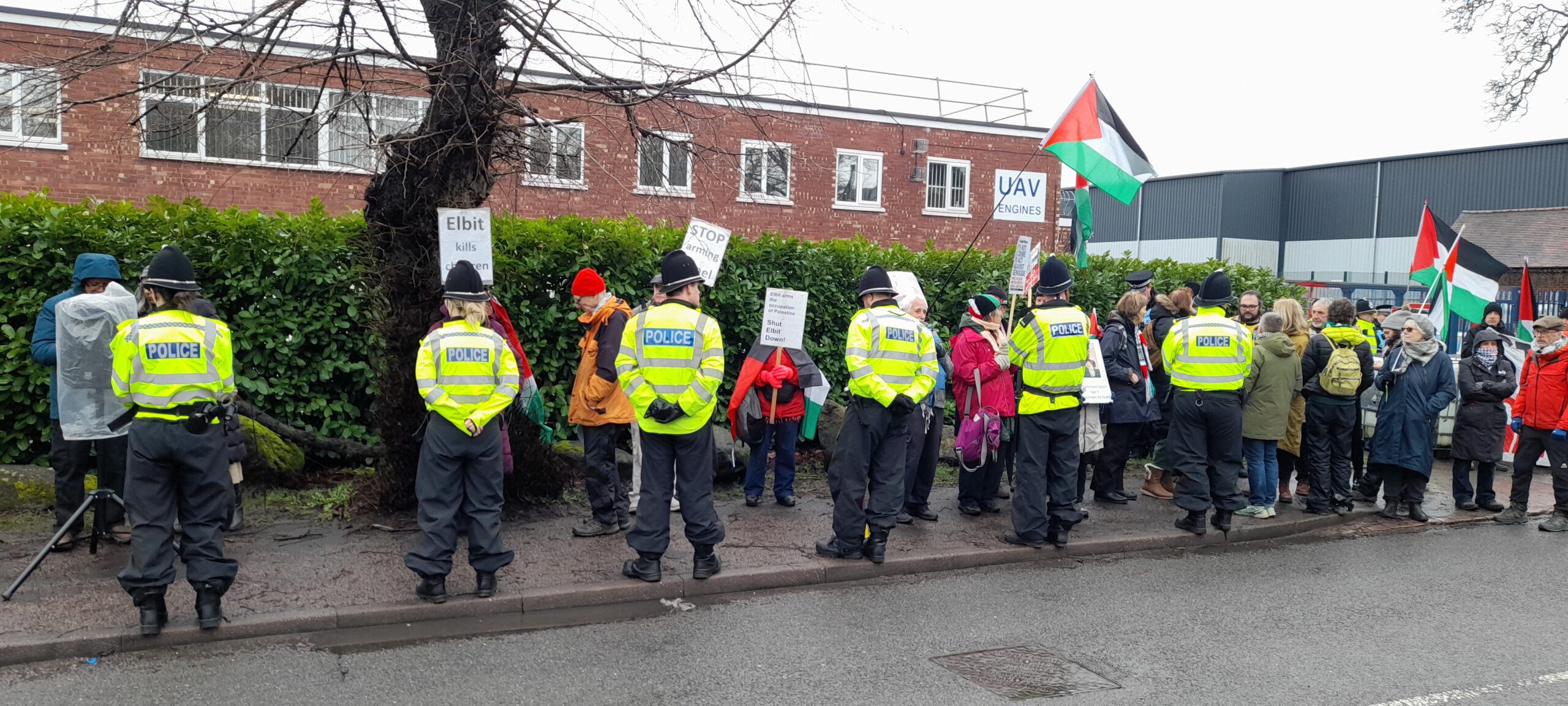
I was at Shenstone again today. It was cold and wet. I have reported on this place before on this blog. I have been there many times in the last twenty years. The same protest repeated over and over. Not many know that I go. I don’t raise it in conversation after Mass, if someone asks about my week. I’ve never put it in a bidding prayer. Some that used to go no longer go. Some others have joined in recent times.

Unmanned Aerial Vehicles Engines Limited. That’s the name. ‘Limited’ they aren’t, of course. ‘Relentless’ might be more accurate, though this would not be recognised in legal argument or business parlance.

This experience is common enough among campaigners, ancient and modern. It was familiar to Jesus and the first followers. They even put it into a parable about a widow and a judge. Luke says this is to focus our minds on the need to keep praying. So, protest can also be prayer, then.

Paul – 27th January 2026

SDSC UK 2026 – An Arms Fair in Search of a Home – Paul McGowan

This Arms Fair has been looking for a home in the Midlands for several years. Having tried Malvern and Telford it has this year turned up at the National Exhibition Centre. The NEC is half-way between Birmingham and Coventry.

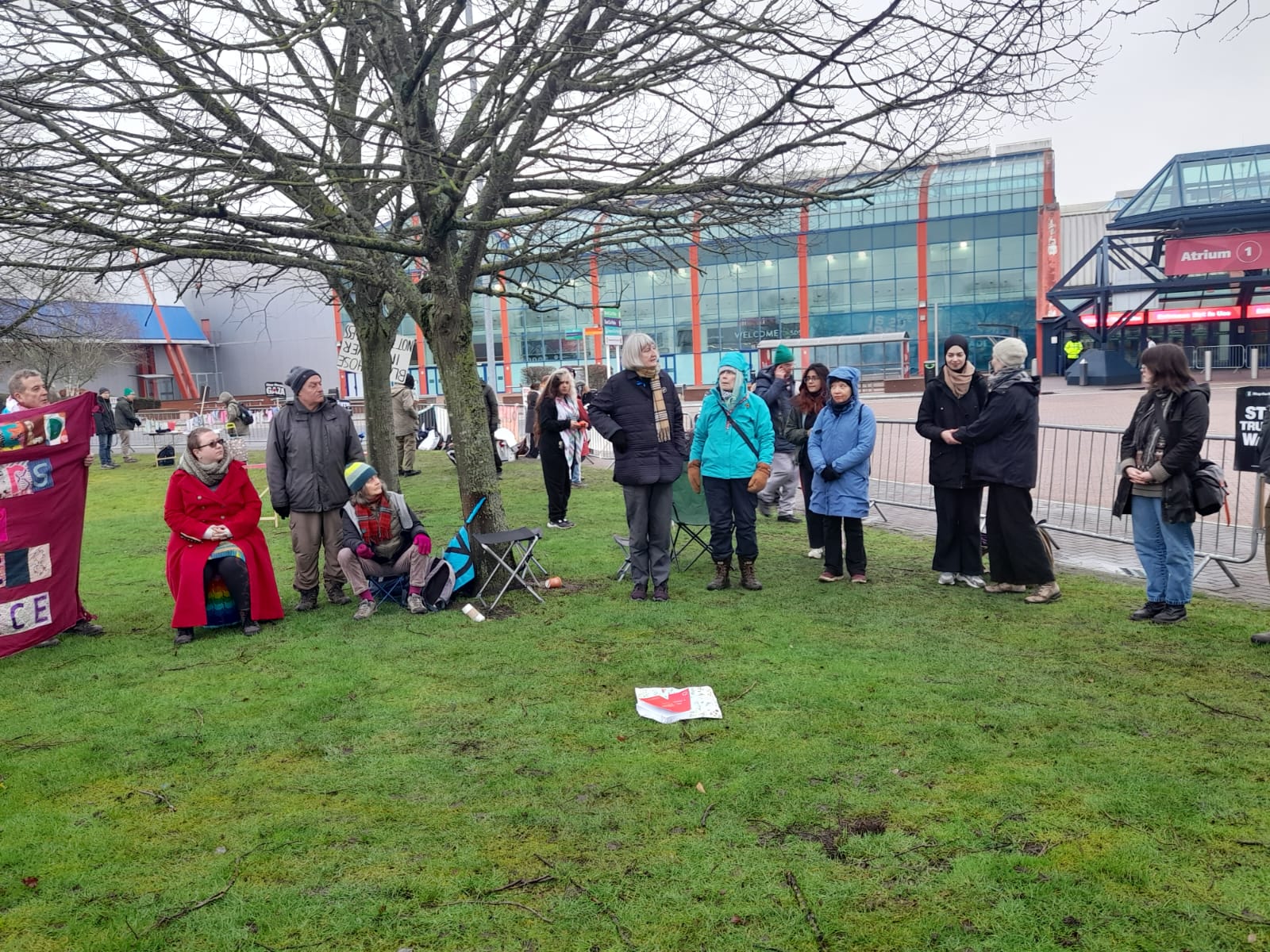
It’s a Convention for a different class of arms-dealers. You won’t find many big hitters here. But the gathering of small companies would no doubt have gladdened the hearts of politicians looking for economic growth. I suppose the firms saw a chance to get noticed by the big hitters and, who knows, bought up for a fortume. The participants would probably deny they were, in fact,  arms-dealers. Well, they would have, if we could have got close enough to talk. As it was, there was a great gulf of fifty yards fixed between us. I’m betting they’ll want the NEC to be their permanent home. Security was tight. Protesters were allowed toilet visits, but only if accompanied by trained staff.

The protesters were in two groups, as it happened. Roughly speaking, Quakers (who had done most of the organising) and Birmingham Stop the War (who just turned up). I still have a soft spot for StW, which is one of those rare statements, and I’d never been to a Quaker-led gathering. It has surprised me to learn that the chanting of the one group and the silence of the other actually perform the same functions, in large part. Identity and purpose.

Which brings me to my final thought. How to communicate? I had brought a placard saying DON’T WORK FOR DEATH AND DESTRUCTION. Not catchy, I know, but I thought it was a message I could suitably direct at the attendees. We were too far away for them to read it, I think. Making a lot of noise is one way round this problem, and some tried it. Some others tried street theatre. 

How effective was it all? Hard to tell and not to worry. “We played music and you wouldn’t dance. We sang dirges and you wouldn’t weep.”

Paul McGowan