Pax Christi Marks International Women’s Day Reflecting on “Unarmed and Disarming Peace”

Sr Katrina Alton, National Chaplain to PCEW
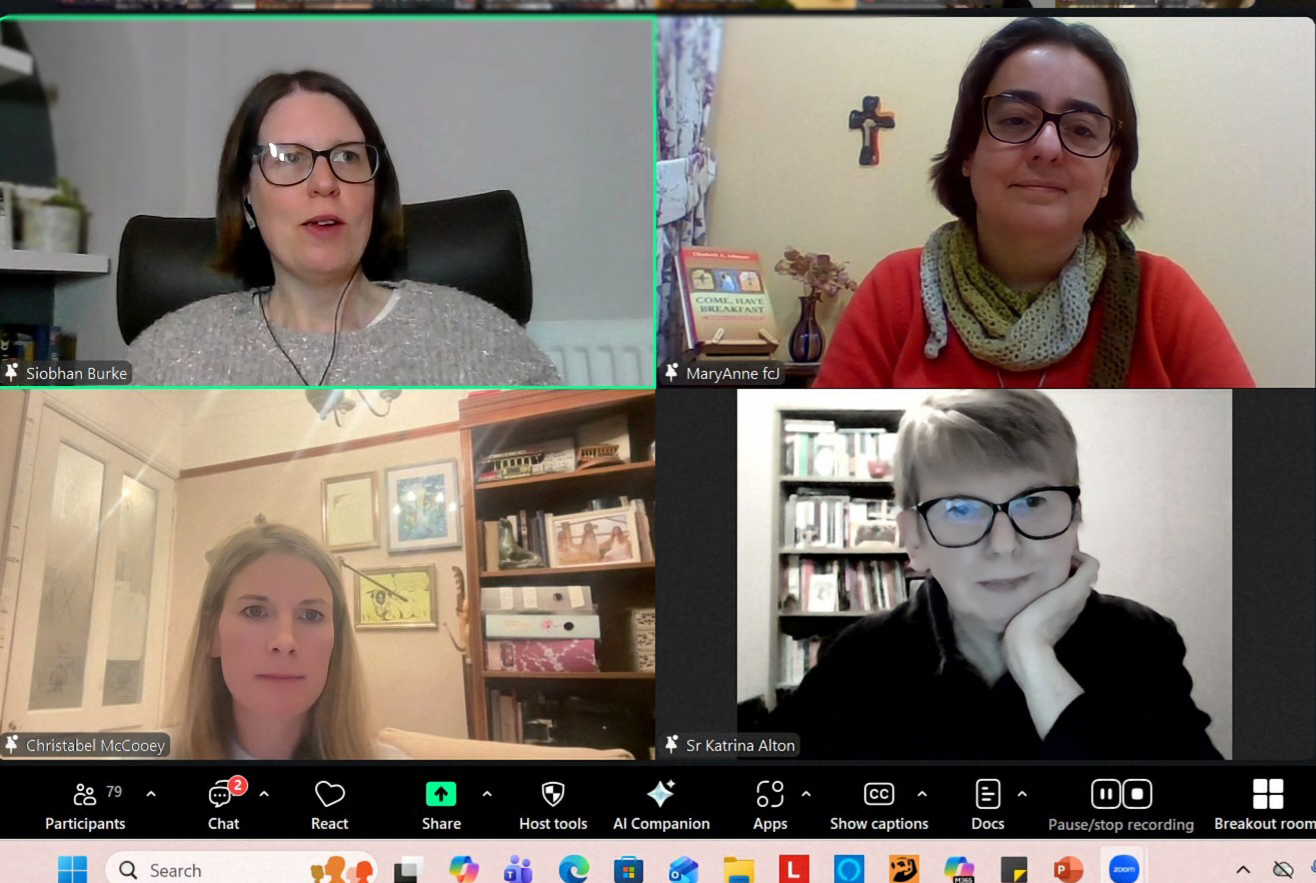
More than 80 participants joined a Pax Christi Zoom gathering on International Women’s Day (8 March) to reflect on the theme “Towards an ‘unarmed’ and ‘disarming’ peace,” inspired by the 2026 World Peace Day message of Pope Leo.

As Chaplain, I was honoured to be joined by three remarkable women: Siobhan Burke, tutor at the St Bede’s Pastoral Centre in York; MaryAnne Francalanza FCJ, Director of the FCJ Centre for Spirituality and EcoJustice; and barrister Christabel McCooey.

International Women’s Day invites us not only to celebrate women’s leadership, wisdom and resilience, but also to listen deeply to women’s voices at the heart of peace-making – listening to one another, and to God. Our opening prayer set the tone:

“God who trusted women with the first yes, the first witness, the first fire.
We remember Mary who carried salvation into the heart of Empire, unarmed and disarming.”

We began with a simple question: What stirs in you when you hear the words “unarmed and disarming peace”?

Reflecting on her work in spiritual accompaniment, Siobhan Burke spoke about how her understanding of peace has evolved:

“Growing up, I thought peace meant avoiding conflict. Now I see that tension and disagreement are part of life. Peace is the ability to work through conflict authentically with others.”

For Siobhan, this requires courage and honesty:

“It’s an invitation to risk difficult conversations, to be vulnerable and real. Learning how to pray with strong emotions—anger, anxiety, fear—is part of cultivating peace.”

For MaryAnne Francalanza FCJ, the word disarming was especially powerful:

“Often something beautiful disarms—a smile, a child, an unexpected act of kindness. Disarmed people can build relationship because the barriers of suspicion fall away.”

Quoting the peace message of Pope Leo XIV, she reminded us:

“Goodness is disarming.”

Yet she acknowledged the challenge:

“It takes courage to approach someone whose views you strongly oppose with goodness and kindness that disarms. It makes you vulnerable. But this is our urgent task as the world becomes more polarised.”

Barrister Christabel McCooey pondered what this means for the justice system: “The Christian faith is marked by love. Love for God, neighbour, and strangely, love for our enemy. Just as in other spaces of public life, there is space for love in the justice system, and to think about how love might inform the delivery of justice.”

In the second part of the gathering, participants shared their own experiences, insights and questions. The conversation highlighted how the work of peace often begins in everyday encounters, through listening, courage, and the willingness to disarm our own hearts.

International Women’s Day reminds us that peace is not only negotiated between nations. It is cultivated in relationships, communities, and spiritual practice.

We ended by committing ourselves again to Jesus’ way of Gospel nonviolence:

“Make us true Gospel women, living interruptions to the logic of violence.
That Your kingdom may come, unarming our hearts, and disarming the world. Amen”
Palestinian Olive Oil used for Holy Oils – Ann Farr

As we approach Holy Week our thoughts and prayers are very much on the Holy Land and particularly on the last days of Jesus, as he approached Jerusalem.

In an act of deep symbolism and solidarity, a number of Catholic and Anglican Dioceses have again chosen Palestinian Olive Oil as the base for their Holy Oils. So far, these include the Catholic Dioceses of Arundel and Brighton and Birmingham, and the Anglican Dioceses of Coventry, and Southwark.

Each year, during the Chrism Mass, the local bishop blesses new oils for the diocese. The holy oils are then taken to each parish, where they are used for Sacramental anointing throughout the year.

This year we are again deeply shocked by all the suffering we see imposed on those in the Holy Land. We have seen indescribable mass destruction of lives, homes and land in Gaza, and the people of the West Bank are seeing destruction and violence that goes far beyond the harassment and obstruction they have experienced for decades. Everyone we met on our solidarity visit in November told us that this was the worst they have ever experienced, and since then it has got worse.

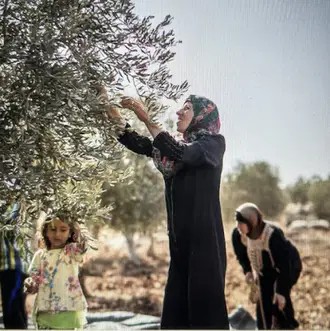
The last olive harvest in Palestine was one of the most difficult in memory. Across the West Bank farmers have faced violence, intimidation and the constant fear of attack. Armed settlers have blocked access to olive groves, set fire to trees and vandalised property. Some have assaulted farmers and their families or threatened them with guns and batons. In some areas, olive trees have been bulldozed or uprooted by the Israeli army. Harvesting for many has become as act of defiance and resilience. Families have had to make an unthinkable choice – to stay away from their groves and let the olives fall, rather than risk their lives and that of their families.

Never has our solidarity and support for the Holy Land been needed more and this Easter it’s good to know that we can be linked in such a special way, through the use of olive oil from the Holy Land, to the Palestinian families who have produced the oil that will be used throughout the year in the Sacraments of the Sick, Baptism and Holy Orders and in the anointing of new bishops.

Canon Rob Esdaile, a priest of Arundel & Brighton Diocese, who has long been active in work for peace and justice, says: “The olive tree has long been a symbol of the heritage of the inhabitants of the Holy Land.

“Psalm 133 uses the vivid image of olive oil running down a man’s beard as a symbol of peace in the community and of  ‘brothers dwelling in unity’, while the same oil was used by Samuel to anoint both King Saul and King David.

“It is beyond tragic that Zionist settlers systematically and deliberately destroy Palestinian olive groves, while the annual olive harvest (always a communal effort in Palestinian villages) in the face of military blockades and the theft of land has become a symbol of resistance and hope. Our liturgical use of Palestinian olive oil is both an act of solidarity and a very physical prayer for the peace of Jerusalem and of the whole Holy Land.”

While we take part in the services of Lent, Holy Week, Easter and Pentecost, we remember that since the war on Iran, all Palestinian places of worship in Jerusalem have been closed by the Israeli Authorities and so denying access to worship for Muslims and Christians. We are asked to keep them in our prayers as we hope for a Just Peace for all in the Holy Land.

If we have missed your Diocese in the list above, please let us know at info@paxchristi.org.uk  and we will make sure you are included.

There is still time to order Palestinian Olive Oil for Holy Week, directly from Zaytoun. It is available in 5 litre cans and in various sized bottles to meet your needs. contact: https://zaytoun.uk  or on

 0207 8321351 or 0781 4477188

Ann Farr,

Pax Christi England and Wales, Pax Christi International, Working Groups for a Just Peace in Palestine and Israel

March 2026

Nostalgia is not a strategy – Professor Ian Linden

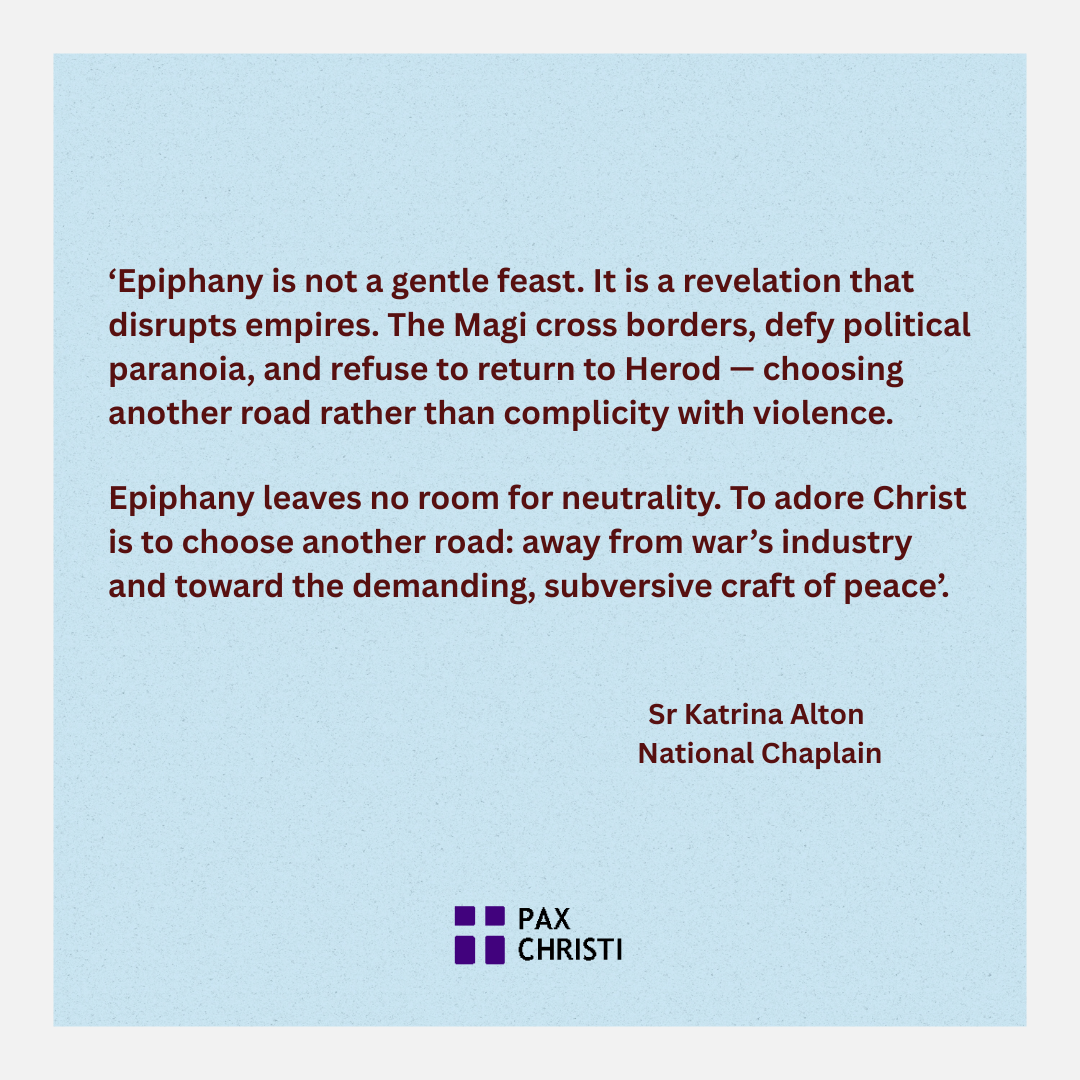
The UN, WTO, WHO, the COP, multilateral institutions on which the world relied, the collective scaffolding intended to build a secure, peaceful, international order, we can rely on no longer.  Three superpowers led by autocratic rulers, China, Russia and the USA, for whom in Hannah Arendt’s words “the distinction between fact and fiction no longer holds”, rule a divided world where Might is Right.  Both theologically and geopolitically we urgently need a plan.

“ We aim to be both principled and pragmatic, principled in our commitment to fundamental values, sovereignty, territorial integrity, the prohibition of the use of force, except when consistent with the UN Charter, and respect for human rights, and pragmatic recognizing that progress is often incremental, that interests diverge, that not every partner will share all of our values”. It – unusually – received a standing ovation.

What does “principled and pragmatic” look like theologically?  Well, the covenant promises between God and humanity, and for that reason between people in shared action for the common good.  Christian hope is confidence in God’s New Testament promises for the future,  providing the purpose and endurance for a long road ahead.

Politics is about the promises we make to each other.  In The Human Condition 1958, Hannah Arendt presents these as our hedge against unpredictability, creating “communities of security”.  The  promise of love and compassion provides the glue that will hold the communities together.  Pope Benedict XVI in his magisterial Caritas in Veritate 2009 wrote: “Reason, by itself, is capable of grasping the equality between men and of giving stability to their civic coexistence, but it cannot establish fraternity.   This originates in a transcendent vocation from God the Father, who loved us first, teaching us through the Son what fraternal charity is.” 

Christian forgiveness – counter-intuitively – might be called pragmatic. Demonstrated by the French priests who went into Bergen-Belsen after the Second World War, they refused to discriminate against Germans in their charitable work.  It formed the basis of a reconciled Europe that could co-operate between nations and build strong societies.  Trying to heal the wounds of apartheid, it motivated South Africa’s Truth and Reconciliation Commission.  It is needed, alongside justice, to rediscover the  fraternity, the friendships, that Benedict wrote about in a divided world.

Professor Ian Linden

Zealous for the repair of potholes – indifferent to the destruction of lives – Paul McGowan

We stood outside the Council House again, with the same banner as last time. And the time before that. And so on. This time I held the banner with a Muslim. OUR COUNCIL TAX FUNDS THE GENOCIDE. We were there to confront the Council and their investments in weaponry. Some councillors came among us, smiled and took photos. It was because elections are approaching, someone said.

I thought of those who have slipped away into the darkness by the roadside, as Rahner puts it. Some who walked the same road while they could. Some who were there from the start, as the early Church emphasised. It’s a long road, though, and it takes its toll. I ought to pray for them. They have done me good.

Most of those companions, present or departed, wouldn’t set foot in a church if you paid them (and some despite their Baptism). And yet ‘companions’ are those ‘sharing bread’. I share bread every week with many who are not my companions on this road. This is confusing.

Too many of us don’t believe any more that the Devil exists, we were told last Sunday at Mass. These companions I’m talking about, though, would be quite happy to call genocide devilish. And arms-dealers. And the politicians who give the orders and sign the cheques. Demons all. A manner of speaking, you may say. But at least they speak, name names, say something, call a spade a spade.

Hope is much spoken of these days. St Thomas calmly points out that Hope is to be oriented to one who is willing and able to provide the outcome we desire. This seems to rule out our councillors. They are zealous for the repair of potholes, but indifferent to the destruction of lives. And our money pays for both.

Paul McGowan – 27th February 2026

80 Years of the United Nations’ General Assembly

On the 10th January 1946, the first session of the General Assembly of the United Nations was held at Central Hall, Westminster. Delegates from over 50 nations attended and were addressed by the then Prime Minister, Clement Attlee who urged courage in the development of the UN. He said:

“Finally, let us be clear as to what is our ultimate fate. It is not just a negation of war but the creation of a world security and freedom, of a world governed by justice and the moral law: We desire, to assert the pre-eminence of right over might and the general good against selfish sectional aims.”  

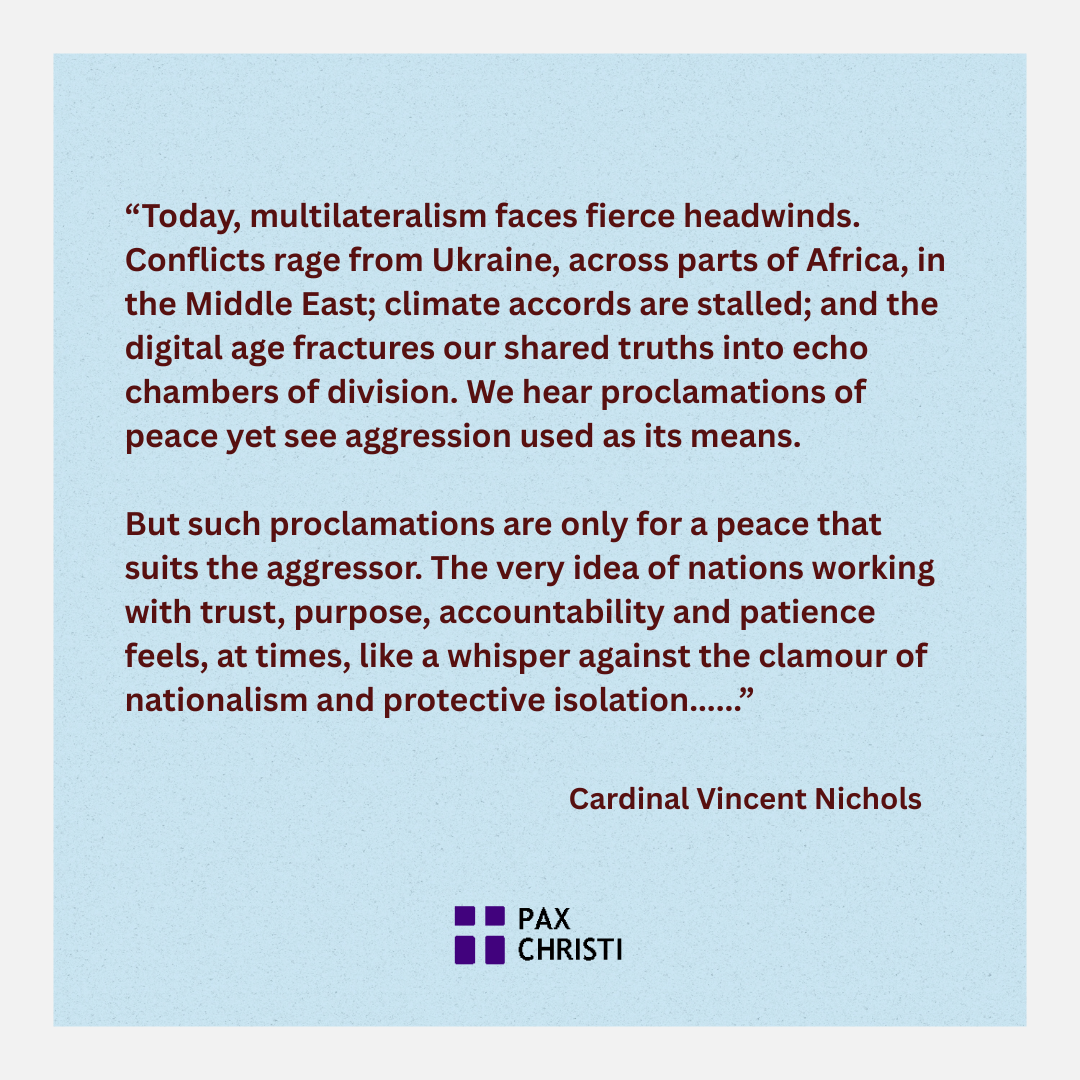
It has been only too clear, even in the last few days and weeks, that the role of the United Nations is under threat and that those ‘selfish sectional aims’ are on the rise and preeminent for a number of world leaders.

Our late Vice President Bruce Kent was a fierce defender and promoter of the United Nations and would have urged us to do all we can to make our own support clear. At our AGM last year, Oliver McTernan encouraged us to consider how we, as Pax Christi, could better support the United Nations and a rules based approach to international relations – whilst also recognising the need for urgent reform – not least in the membership and working of the Security Council.

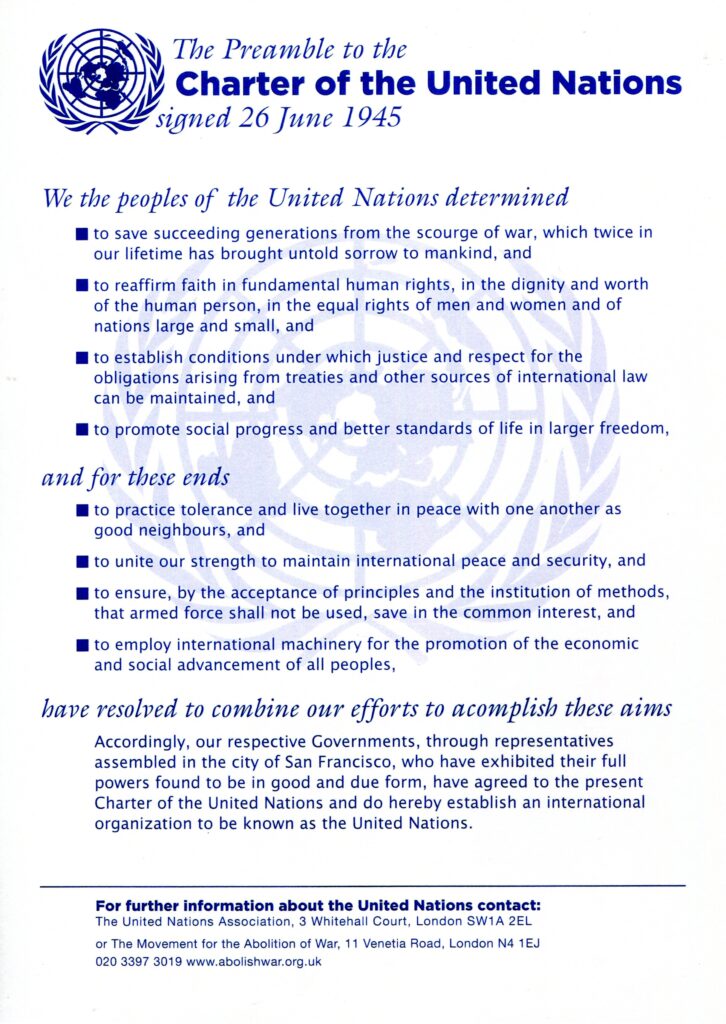
One of the actions Bruce Kent took was to repeatedly print and distribute A4 cards setting out the Preamble to the United Nations Charter. Why not order some of those cards and find somewhere they can be displayed. They are available from the Movement for the Abolition of War website here:

abolishwar.net/shop/preamble-to-the-united-nations-charter/

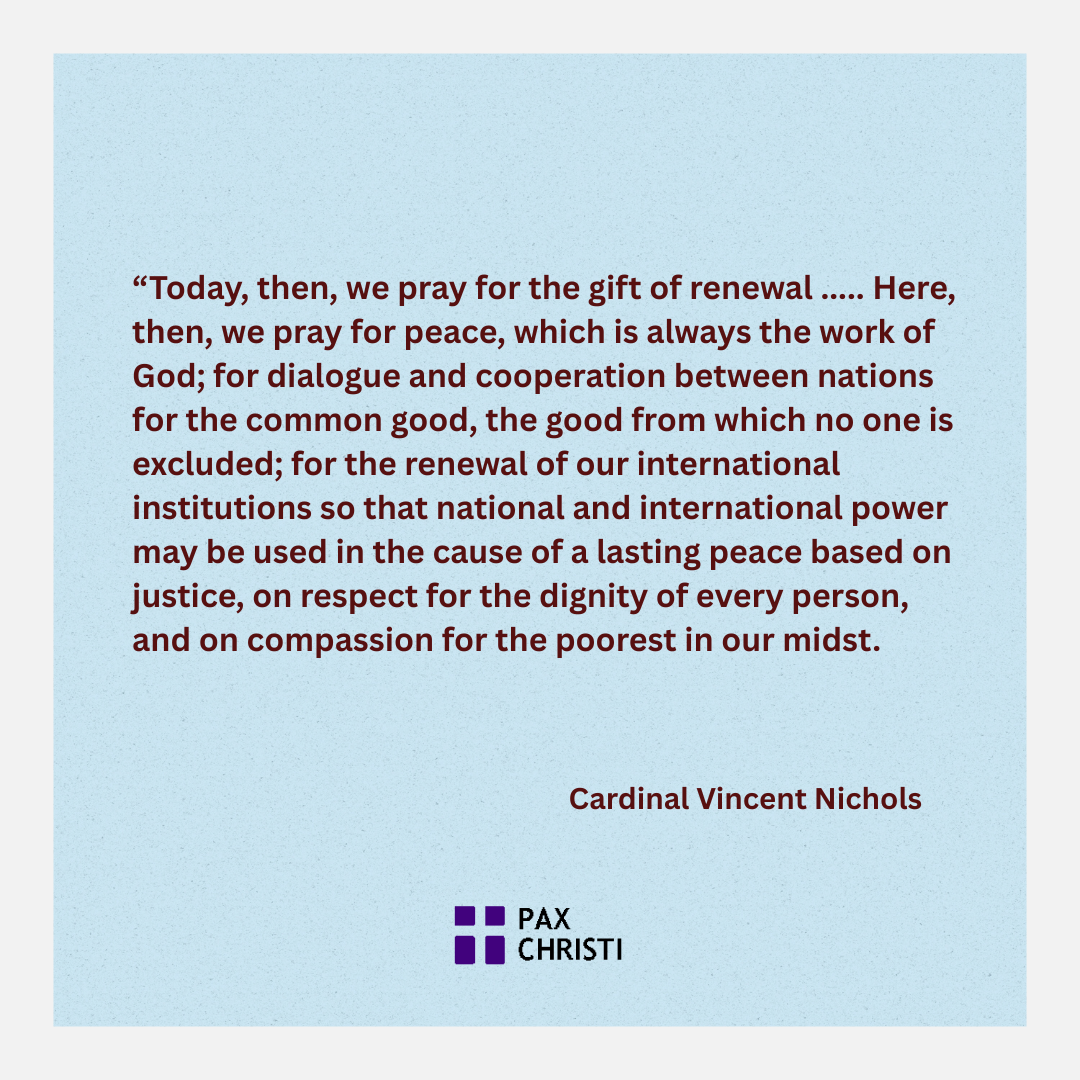
At a Service of Thanksgiving to mark the 80th anniversary of that first meeting of the General Assembly, Cardinal Vincent Nichols gave what our Vice President Pat Gaffney called a ‘most powerful and heartfelt’ homily. We’d recommend reading the homily in full which you can find here:

https://rcdow.org.uk/cardinal/homilies/80th-anniversary-of-the-united-nations