80 Years of the United Nations’ General Assembly

On the 10th January 1946, the first session of the General Assembly of the United Nations was held at Central Hall, Westminster. Delegates from over 50 nations attended and were addressed by the then Prime Minister, Clement Attlee who urged courage in the development of the UN. He said:

“Finally, let us be clear as to what is our ultimate fate. It is not just a negation of war but the creation of a world security and freedom, of a world governed by justice and the moral law: We desire, to assert the pre-eminence of right over might and the general good against selfish sectional aims.”  

It has been only too clear, even in the last few days and weeks, that the role of the United Nations is under threat and that those ‘selfish sectional aims’ are on the rise and preeminent for a number of world leaders.

Our late Vice President Bruce Kent was a fierce defender and promoter of the United Nations and would have urged us to do all we can to make our own support clear. At our AGM last year, Oliver McTernan encouraged us to consider how we, as Pax Christi, could better support the United Nations and a rules based approach to international relations – whilst also recognising the need for urgent reform – not least in the membership and working of the Security Council.
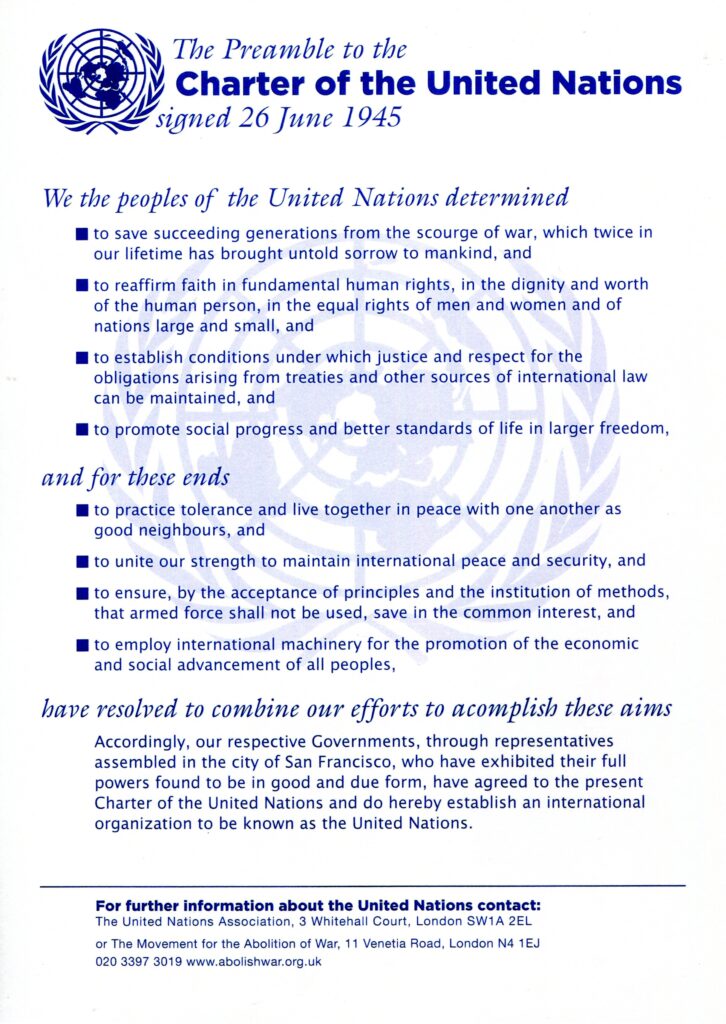
One of the actions Bruce Kent took was to repeatedly print and distribute A4 cards setting out the Preamble to the United Nations Charter. Why not order some of those cards and find somewhere they can be displayed. They are available from the Movement for the Abolition of War website here:

abolishwar.net/shop/preamble-to-the-united-nations-charter/

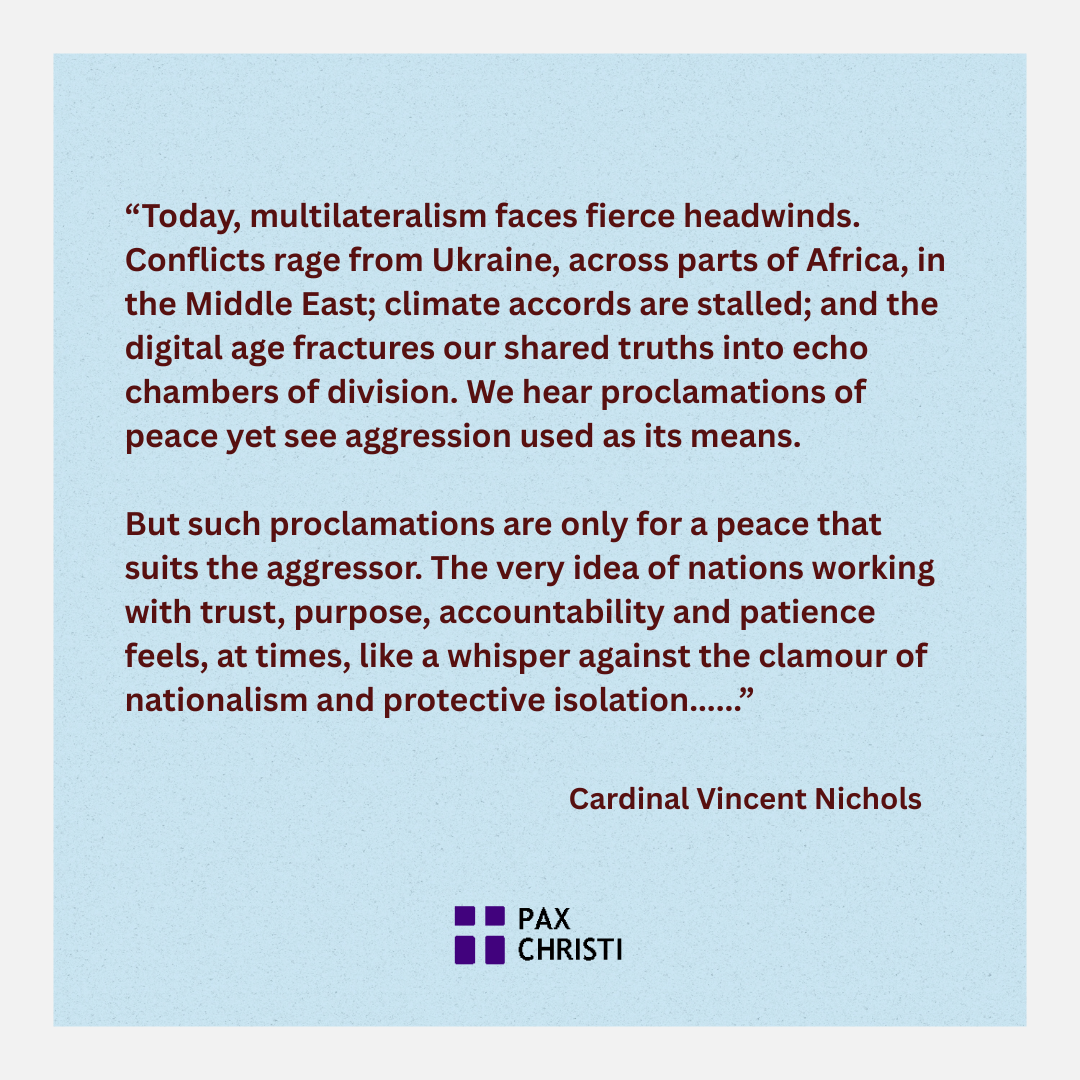
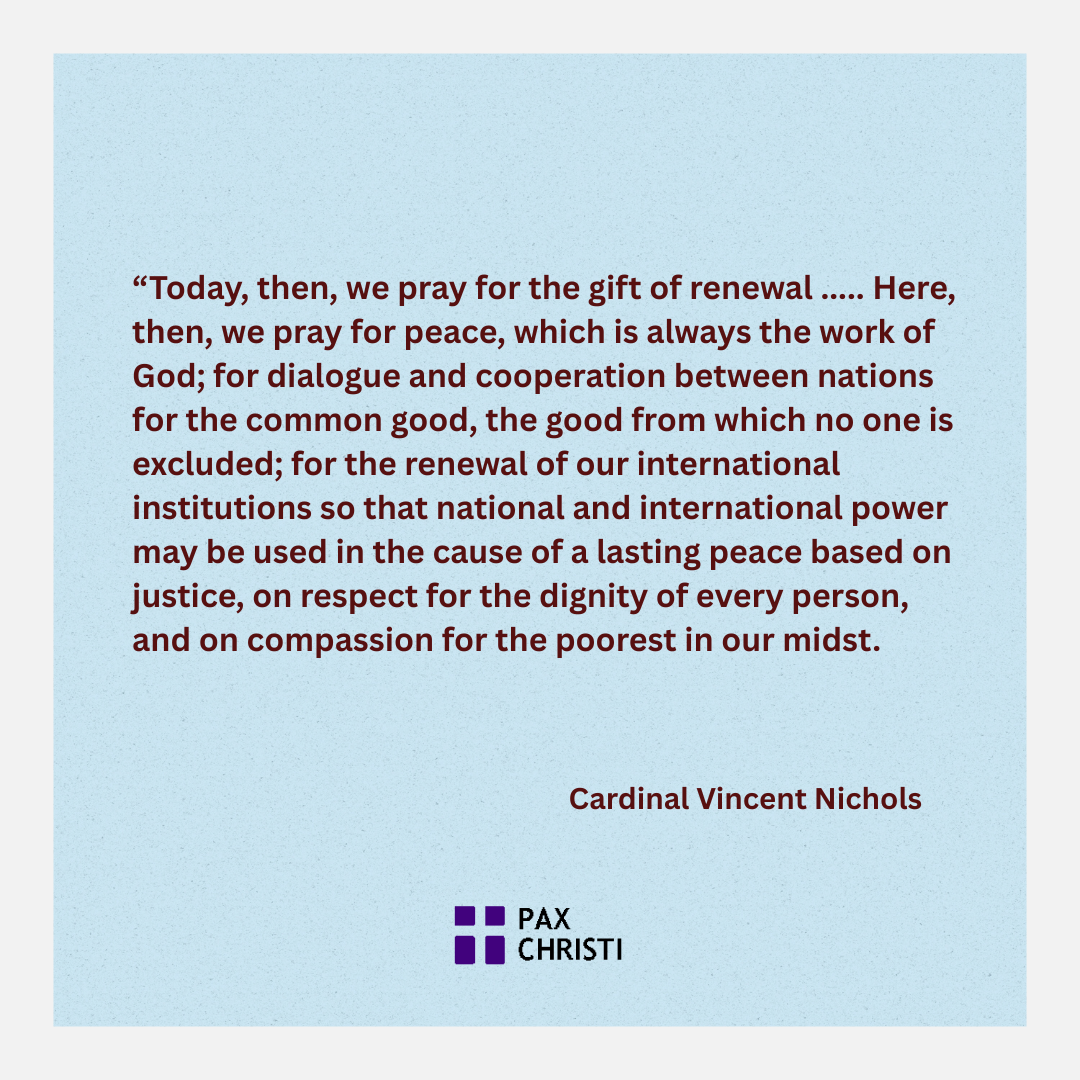
At a Service of Thanksgiving to mark the 80th anniversary of that first meeting of the General Assembly, Cardinal Vincent Nichols gave what our Vice President Pat Gaffney called a ‘most powerful and heartfelt’ homily. We’d recommend reading the homily in full which you can find here:

https://rcdow.org.uk/cardinal/homilies/80th-anniversary-of-the-united-nations
Disarming the Abyss: A Gospel Nonviolence Response to the Attacks on Iran – Sr Katrina Alton

As missiles streaked across the skies of the Middle East and airstrikes pounded cities from Tehran to the Gulf, Christian leaders responded not with calls for retaliation, but with a renewed appeal for peace grounded in Gospel nonviolence. In the wake of coordinated attacks by the United States and Israel on Iranian targets, and Iran’s swift reprisals, voices from Rome to Jerusalem have insisted that peace cannot be forged through the raging heat of war.

During the Sunday Angelus, Pope Leo XIV expressed “deep concern” over the escalating violence. “Stability and peace are not built with mutual threats, nor with weapons, which sow destruction, pain, and death,” he warned, urging leaders to assume their moral responsibility before the spiral of violence becomes “an irreparable abyss.” His appeal reflects the heart of Gospel nonviolence: a conviction that authentic security arises not from domination, but from dialogue rooted in justice and the dignity of every human person.

From the epicentre of the crisis, The Most Reverend Dr. Hosam E. Naoum, Primate of the Anglican Province of Jerusalem & the Middle East, described communities “huddled in shelters, fearing for their lives.” Every nation now engaged in the conflict lies within his ecclesiastical jurisdiction. Yet even as bombs fall, he calls the Church to remember Christ’s words: “Blessed are the peacemakers.” Rejecting the “spirit of fear,” he urges Christians to be “Bridge Builders,” refusing to see neighbours in Tehran, Tel Aviv, or Gulf military bases as enemies.

Their appeals echo the longstanding witness of Pax Christi International, which has condemned the strikes as an escalation that spreads fear and suffering. Grounded in the belief that violence begets only deeper wounds, Pax Christi reiterates that peace cannot be imposed through force or foreign intervention.

In fidelity to Gospel nonviolence, Pax Christi International calls on the international community to:

  • Act to immediately de-escalate hostilities
  • Uphold international law and the UN Charter
  • Return to dialogue and negotiated solutions
  • Protect civilians and respect human dignity

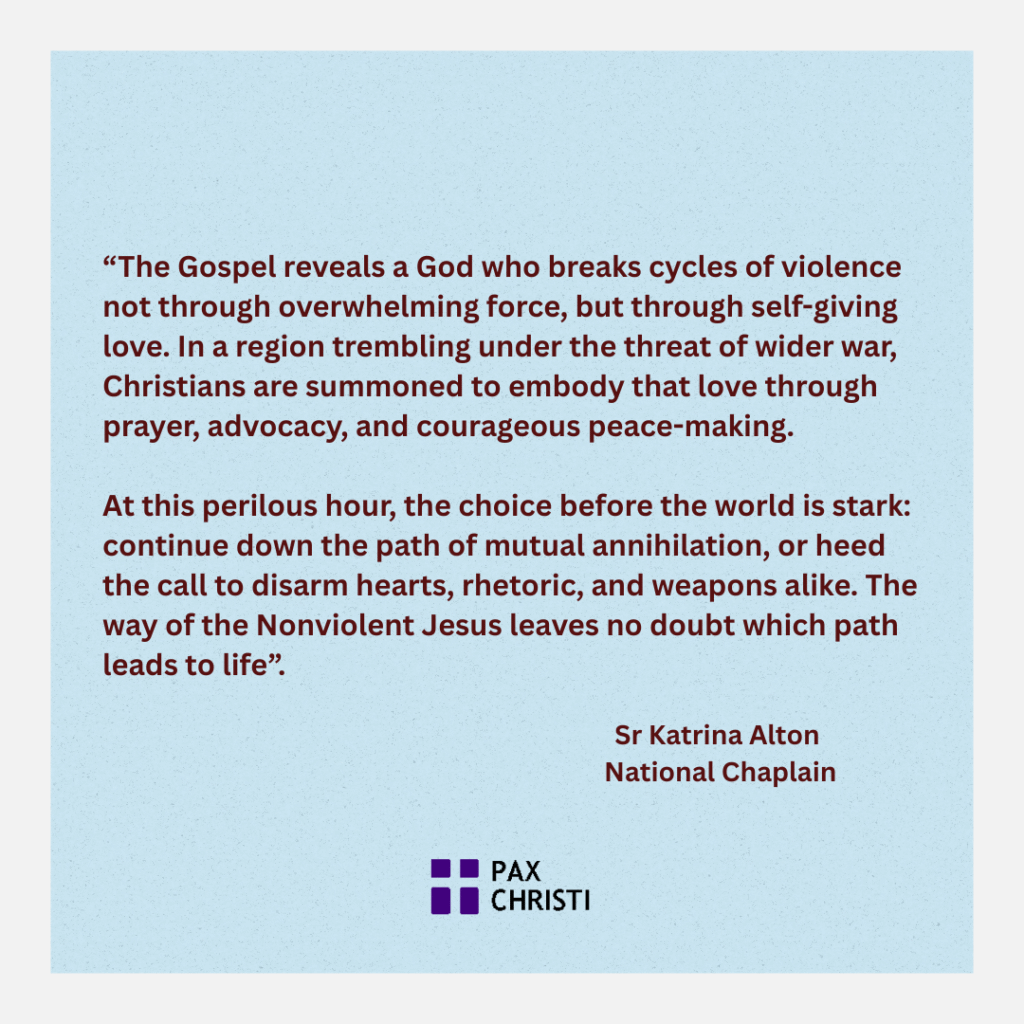
These are not abstract ideals but urgent moral imperatives. The Gospel reveals a God who breaks cycles of violence not through overwhelming force, but through self-giving love. In a region trembling under the threat of wider war, Christians are summoned to embody that love through prayer, advocacy, and courageous peace-making.

At this perilous hour, the choice before the world is stark: continue down the path of mutual annihilation, or heed the call to disarm hearts, rhetoric, and weapons alike. The way of the Nonviolent Jesus leaves no doubt which path leads to life.

Sr Katrina Alton

Five years of the Treaty on the Prohibition of Nuclear Weapons

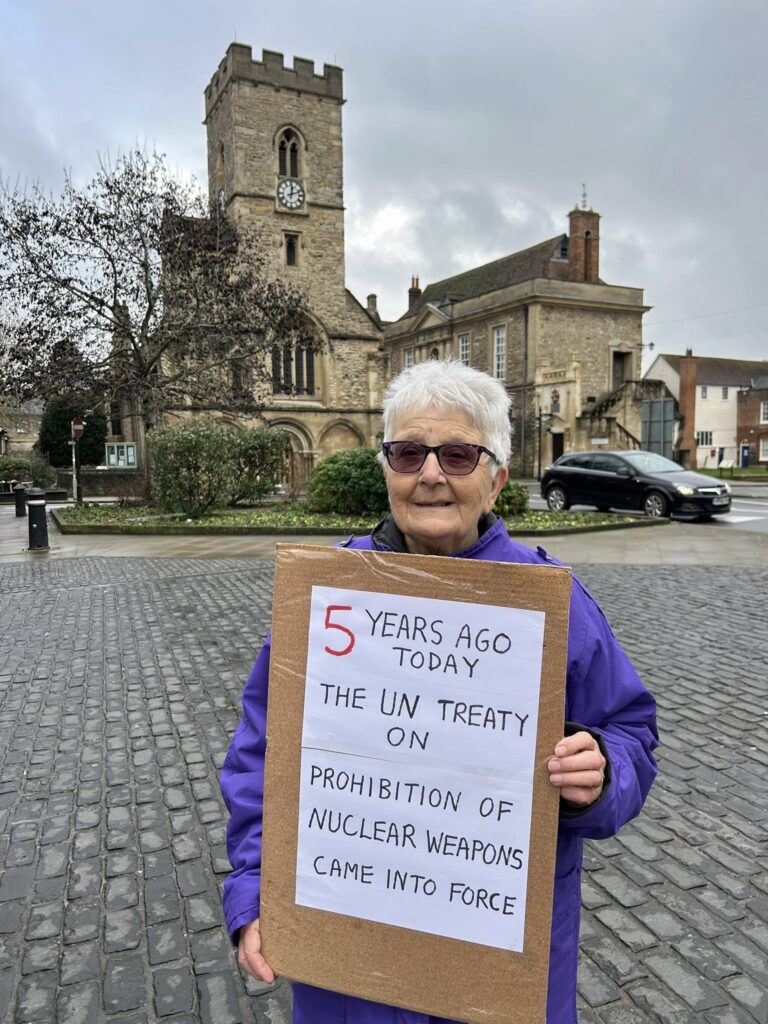
The 22nd January was the 5th Anniversary of the Treaty on the Prohibition of Nuclear Weapons coming into force.

This landmark Treaty imposed a comprehensive ban on nuclear weapons, making it illegal to (amongst other things) develop, possess, use or threaten to use them. A total of 74 states have now ratified or acceded to the Treaty and a further 25 States have signed the Treaty but are yet to ratify it. There is a growing majority bringing moral pressure on the nuclear armed states, including the UK, to make much greater progress on nuclear disarmament.

The Catholic Church supports the Treaty and its aims. The Holy See signed the Treaty on the day it was opened for signature. Both Pope Francis and Pope Leo have confirmed that Catholic teaching requires disarmament and a world free of nuclear weapons. Pope Francis said that it is not just the use of nuclear weapons that is immoral but ‘their very possession’. In his message for the World Day of Peace (the message we reflected on for Peace Sunday last weekend), Pope Leo said ‘The idea of the deterrent power of military might, especially nuclear deterrence, is based on the irrationality of relations between nations, built not on law, justice and trust, but on fear and domination by force’.

The UK’s approach to the TPNW has been recalcitrant, constantly refusing to engage with the Treaty processes whilst at the same time failing to fulfil its obligations as a party to the Nuclear Proliferation Treaty – the treaty which it claims is the only route to nuclear disarmament.

As we mark the 5th anniversary of the TPNW, we confirm that, in the words of the Catholic Bishops’ Conference (England and Wales) in ‘Called to be Peacemakers’, we continue in ‘prayer and public witness’ to campaign for the UK to sign and ratify the Treaty and, until they do, engage meaningfully with the treaty framework, not least in participating as an observer in future meetings of signatories.

Take Action on Nuclear Weapons

If you would like to be involved in our campaigns on Nuclear Weapons, why not join other members and supporters in our Disarmament Working Group ? For more detail, contact us on info@paxchristi.org.uk

Also have a look at our calendar of events where you will find details of a number of upcoming webinars on nuclear weapons themes.

And why not read this short article by Jonathan Frerichs, Pax Christi International Main Representative at UN Geneva:

Half the world’s countries are united in new Nuclear Ban Treaty

Image: Former Vice President and Pax Christi Member Ann Dodd marking the 5th anniversary of the TPNW with Abingdon Peace Group

A meeting of hope – Martin Birdseye

Being more involved with ICAN UK recently, (as Pax Christi’s regular representative) I seized the opportunity to attend a meeting with Melissa Parke, Executive Director of ICAN.  Melissa was in London last week for meetings with MPs and made time for a short in‑person meeting with ICAN UK supporters. 

Not many were present because of short notice but there was a sufficient variety of people to generate an inspiring round-table discussion.

What could have been not much different from an ordinary meeting of ICAN UK supporters, was transformed by having to introduce ourselves and our projects to Melissa, leader of the global ICAN project to abolish nuclear weapons!    The marvellous variety, vision and long-term perseverance of UK campaigning became very apparent.

Having explained my connections with Christian CND and Pax Christi I outlined the ideas and origins of the You Decide nuclear morality flowchart project.  I find that the value of the ethical approach in promoting disarmament is now much better understood (probably since the TPNW and its “ethical imperatives…”) so it’s much easier to explain a logical decide-for-yourself approach to resolving the morality of nuclear deterrence.  Jude Madubuike, now leader of the project, then went on to explain how it is now established as the You Decide CIC, moving ahead and looking for new resources.  We were encouraged by the positive response in this illustrious company.

Melissa briefed us on some latest concerns, and campaign policy.  AI now escalates war scenarios: because while final decisions can be reserved for human intervention, many of the inputs to decision will be generated by AI.  The New Start Treaty is now lapsed.  We have to move the world on from just arms control to disarmament.  Nuclear deterrence must be seen for what it is, the ultimate form of terrorism.  Meanwhile ICAN is working on a platform that will enable more collaborative work among the ICAN partner organisations.  This is work in progress. (We are planning for You Decide to be registered as an ICAN partner organisation.)

A strong theme in discussion was hope.  We have to wake people up but avoid alarmist panic and despair.  Support for abolition depends on a belief that it can be done.

Indeed it can!  Look to the TPNW!

Martin Birdseye

15th February 2026

http://nuclearmorality.com/

https://www.icanw.org/melissa_parke

Ash Wednesday, Repentance and A Disarming Peace – Sr Katrina Alton

Ash Wednesday confronts the Church with an unambiguous anthropological truth: “You are dust, and to dust you shall return.” The liturgy dismantles fantasies of permanence and control, situating human life within its proper limits before God.

It is from this starting point that Pope Leo’s 2026 World Day Peace message, “Peace be with you all: Towards an ‘unarmed and disarming’ peace,” must be read. The message is not a technical policy proposal but a theological reorientation. It directly challenges the reigning security logic of our age, especially the moral legitimacy granted to nuclear “deterrence”. The claim that peace can be preserved through the credible threat of mass annihilation stands in stark tension with Christian ethics and with the Gospel’s revelation of salvation.

The Ash Wednesday readings sharpen this tension. Joel’s command to “rend your hearts, not your garments” (Joel 2:13) exposes religious gestures that leave unjust structures untouched. Psalm 51 gives voice to repentance stripped of self-justification, naming sin as a rupture in right relationship with God and neighbour. Paul’s urgent declaration— “now is the acceptable time” (2 Cor 6:2)—eliminates the comfort of moral delay, while Jesus’ teaching in Matthew 6 dismantles piety performed for legitimacy rather than truth. Together, these texts resist abstraction, evasion, and postponement.

Seen through this lens, nuclear weapons are not merely a phoney strategy for true peace and security, they are a theological scandal. They embody a moral logic that normalizes preparation for indiscriminate mass destruction while blessing it in the language of “necessity and stability”. Their vast financial cost constitutes an economic injustice, siphoning resources from life-giving needs. Their environmental consequences implicate them in ecological sin. Most deeply, they deform moral imagination by training societies to accept possible annihilation as a condition of peace.

Biblical repentance, however, is never confined to private conscience. Joel’s summons is addressed to a people. Psalm 51’s plea for a clean heart does not license God’s blessing of violent systems. Paul’s insistence on immediacy leaves no room for deferral in the face of structural sin. Christian conversion necessarily carries social, political, and economic consequences.

At the centre of this critique stands Christ himself. Jesus offers no peace rooted in domination or violence. The peace he embodies is revealed in the Way of the Cross: a nonviolence that refuses retaliation and exposes the lie that violence secures life. In accepting suffering rather than inflicting it, Jesus disarms the logic of Empire. The resurrection vindicates not the architects of death, but the one who entrusted himself entirely to God.

A “disarming peace,” then, is neither passive nor naïve. It demands a reconfiguration of Christian imagination: prayer that leads to nonviolent resistance, fasting that exposes structural sin, and almsgiving that redistributes resources away from the production of nuclear weapons.

Ash Wednesday marks our bodies with ashes to interrupt illusions of invulnerability. Empires pass. Weapons corrode. What endures is the mercy of God and the call to conversion. Now is the time!

Sr Katrina Alton