

As missiles streaked across the skies of the Middle East and airstrikes pounded cities from Tehran to the Gulf, Christian leaders responded not with calls for retaliation, but with a renewed appeal for peace grounded in Gospel nonviolence. In the wake of coordinated attacks by the United States and Israel on Iranian targets, and Iran’s swift reprisals, voices from Rome to Jerusalem have insisted that peace cannot be forged through the raging heat of war.
During the Sunday Angelus, Pope Leo XIV expressed “deep concern” over the escalating violence. “Stability and peace are not built with mutual threats, nor with weapons, which sow destruction, pain, and death,” he warned, urging leaders to assume their moral responsibility before the spiral of violence becomes “an irreparable abyss.” His appeal reflects the heart of Gospel nonviolence: a conviction that authentic security arises not from domination, but from dialogue rooted in justice and the dignity of every human person.
From the epicentre of the crisis, The Most Reverend Dr. Hosam E. Naoum, Primate of the Anglican Province of Jerusalem & the Middle East, described communities “huddled in shelters, fearing for their lives.” Every nation now engaged in the conflict lies within his ecclesiastical jurisdiction. Yet even as bombs fall, he calls the Church to remember Christ’s words: “Blessed are the peacemakers.” Rejecting the “spirit of fear,” he urges Christians to be “Bridge Builders,” refusing to see neighbours in Tehran, Tel Aviv, or Gulf military bases as enemies.
Their appeals echo the longstanding witness of Pax Christi International, which has condemned the strikes as an escalation that spreads fear and suffering. Grounded in the belief that violence begets only deeper wounds, Pax Christi reiterates that peace cannot be imposed through force or foreign intervention.
In fidelity to Gospel nonviolence, Pax Christi International calls on the international community to:
- Act to immediately de-escalate hostilities
- Uphold international law and the UN Charter
- Return to dialogue and negotiated solutions
- Protect civilians and respect human dignity
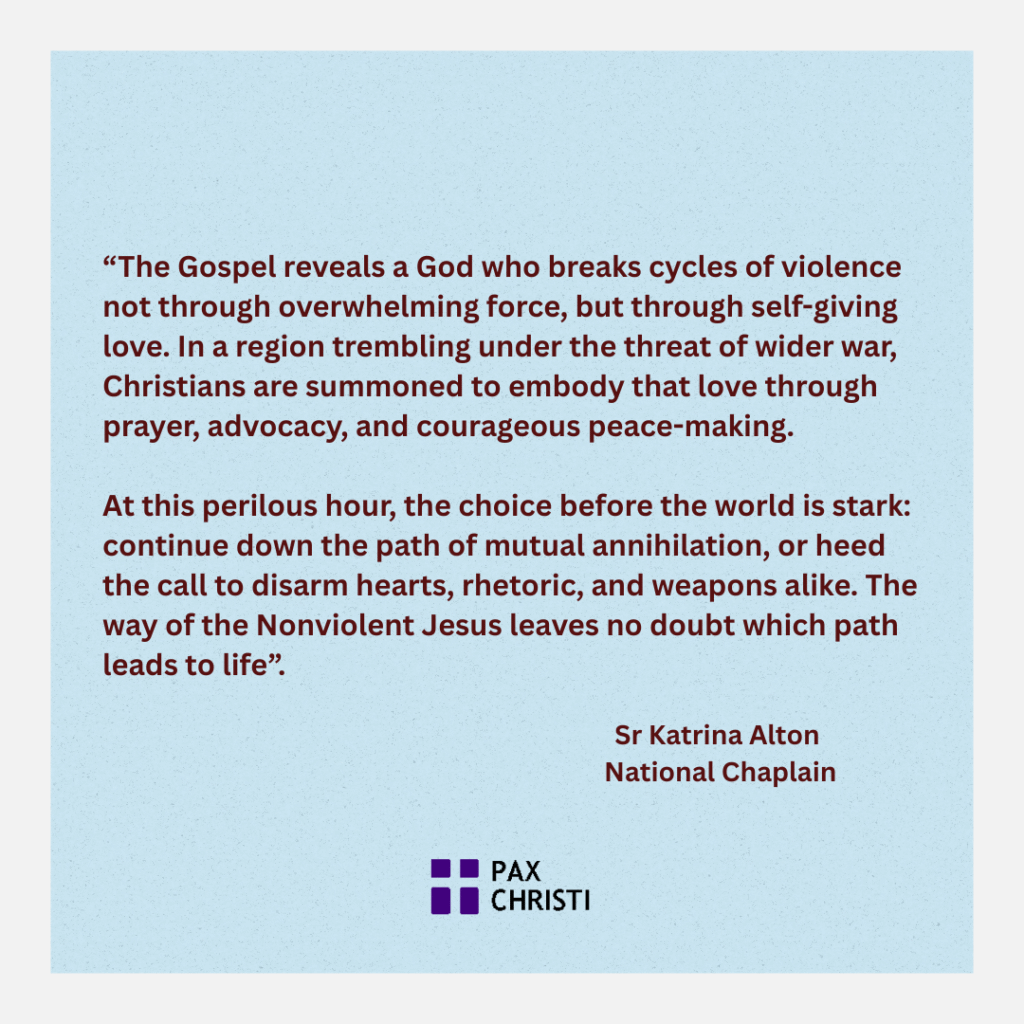
These are not abstract ideals but urgent moral imperatives. The Gospel reveals a God who breaks cycles of violence not through overwhelming force, but through self-giving love. In a region trembling under the threat of wider war, Christians are summoned to embody that love through prayer, advocacy, and courageous peace-making.
At this perilous hour, the choice before the world is stark: continue down the path of mutual annihilation, or heed the call to disarm hearts, rhetoric, and weapons alike. The way of the Nonviolent Jesus leaves no doubt which path leads to life.
Sr Katrina Alton

